Define radioactivity. If an element has three isotopes, which of them (the lightest, the one with an intermediate mass, or the heaviest) is most likely to be a radioisotope, and why?
Ch. 2 Basic Chemistry

2장, 문제 16
Define molecule as it relates to molecular substances and compounds.
검증된 단계별 안내1
A molecule is defined as the smallest unit of a chemical substance that retains its chemical properties and is composed of two or more atoms bonded together.
Molecules can consist of atoms of the same element (e.g., O₂ for oxygen gas) or different elements (e.g., H₂O for water).
Molecular substances are composed of molecules held together by covalent bonds, which involve the sharing of electrons between atoms.
Compounds are a specific type of molecule that consist of two or more different elements chemically combined in fixed proportions (e.g., CO₂ for carbon dioxide).
In summary, molecules are the building blocks of molecular substances and compounds, with compounds being a subset of molecules that include multiple types of elements.

비슷한 문제에 대한 검증된 영상 답변:
이 영상 해법은 위 문제에 도움이 된다고 튜터들이 추천한 것입니다.
영상 길이:
2m도움이 되었나요?
주요 개념
질문에 올바르게 답하기 위해 반드시 이해해야 하는 핵심 개념들은 다음과 같습니다.
Molecule
A molecule is the smallest unit of a chemical substance that retains its chemical properties. It consists of two or more atoms bonded together, which can be of the same or different elements. Molecules can exist independently and are the building blocks of molecular substances and compounds.
추천 영상:
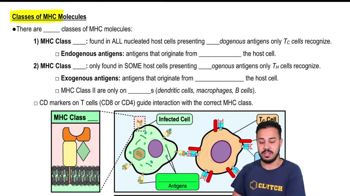
Classes of MHC Molecules
Molecular Substances
Molecular substances are composed of molecules formed by covalent bonds between atoms. These substances typically have low melting and boiling points and can exist in various states (solid, liquid, gas) at room temperature. Examples include water (H2O) and carbon dioxide (CO2), which illustrate the diversity of molecular substances.
추천 영상:
가이드 코스
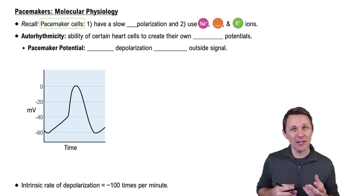
Pacemakers: Molecular Physiology
Compounds
Compounds are substances formed when two or more different elements chemically bond together in fixed proportions. They can be molecular, consisting of molecules, or ionic, consisting of ions. Compounds exhibit unique properties that differ from the individual elements that compose them, such as sodium chloride (NaCl), which is a compound formed from sodium and chlorine.
추천 영상:
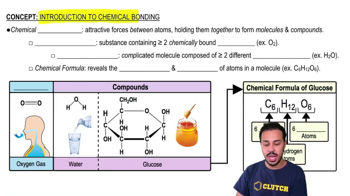
Introduction to Chemical Bonding
관련 실천
교과서 질문
57
views
교과서 질문
Matter occupies space and has mass. Explain how energy must be described in terms of these two factors. Then define energy.
54
views
교과서 질문
What are hydrogen bonds, and how are they important in the body?
206
views
교과서 질문
Name and provide the atomic symbols of the four elements that make up the bulk of all living matter. Which of these is found primarily in proteins and nucleic acids?
44
views
교과서 질문
Describe how the two 'generic' atoms shown below would form an ionic bond. Include in your answer where electrons come from, where they go, and why.
59
views
교과서 질문
Identify each of the following reactions as a synthesis, decomposition, or exchange reaction:
2Hg + O₂ 2HgO
Fe²¹ + CuSO₄ → FeSO₄ + Cu²¹
HCl + NaOH → NaCl + H₂O
HNO₃ → H⁺ + NO₃⁻
140
views