Ch. 2 Basic Chemistry
Marieb - Essentials of Human Anatomy & Physiology 13th Edition
Marieb13th EditionEssentials of Human Anatomy & PhysiologyISBN: 9780135624340당신이 사용하는 게 아니라요?교과서 변경
2장, 문제 17

Describe how the two 'generic' atoms shown below would form an ionic bond. Include in your answer where electrons come from, where they go, and why.

검증된 단계별 안내
1
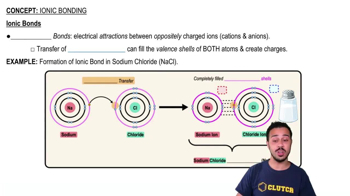
Step 1: Understand the concept of ionic bonding. Ionic bonds form when one atom donates electrons to another atom, resulting in the formation of oppositely charged ions that attract each other. This typically occurs between a metal and a non-metal.
Step 2: Identify the role of each atom in the bond. The atom with fewer electrons in its outer shell (usually a metal) will lose electrons to achieve a stable electron configuration, becoming a positively charged ion (cation). The atom with more room in its outer shell (usually a non-metal) will gain electrons to achieve stability, becoming a negatively charged ion (anion).
Step 3: Describe the movement of electrons. Electrons are transferred from the outer shell of the metal atom to the outer shell of the non-metal atom. This transfer allows both atoms to achieve a full outer shell, following the octet rule (or duet rule for smaller atoms like hydrogen).
Step 4: Explain the resulting charges. The atom that loses electrons becomes positively charged because it has more protons than electrons. The atom that gains electrons becomes negatively charged because it has more electrons than protons.
Step 5: Highlight the electrostatic attraction. The oppositely charged ions (cation and anion) are held together by strong electrostatic forces, forming the ionic bond. This bond creates a stable compound with a neutral overall charge.

비슷한 문제에 대한 검증된 영상 답변:

이 영상 해법은 위 문제에 도움이 된다고 튜터들이 추천한 것입니다.
영상 길이:
1m
도움이 되었나요?

주요 개념

질문에 올바르게 답하기 위해 반드시 이해해야 하는 핵심 개념들은 다음과 같습니다.

Ionic Bonding

Ionic bonding occurs when one atom donates an electron to another, resulting in the formation of charged ions. This process typically involves a metal atom losing one or more electrons to become a positively charged cation, while a non-metal atom gains those electrons to become a negatively charged anion. The electrostatic attraction between these oppositely charged ions creates a strong bond, stabilizing the compound.
추천 영상:
06:07
Ionic Bonds

Electron Transfer

In ionic bonding, electrons are transferred from the atom with a lower electronegativity (usually a metal) to the atom with a higher electronegativity (usually a non-metal). This transfer results in the formation of ions: the metal becomes a cation by losing electrons, and the non-metal becomes an anion by gaining those electrons. Understanding this transfer is crucial for explaining the formation of ionic compounds.
추천 영상:
07:41
Electron Transport Chain

Electronegativity

Electronegativity is a measure of an atom's ability to attract and hold onto electrons. In the context of ionic bonding, the difference in electronegativity between the two atoms determines the likelihood of electron transfer. A significant difference indicates that one atom will effectively pull electrons away from the other, leading to the formation of ions and the resulting ionic bond.
추천 영상:
04:28
Covalent Bonds