How does a cytotoxic T cell destroy another cell displaying antigens bound to class I MHC proteins?
Ch. 22 The Lymphatic System and Immunity

Martini, Nath, Bartholomew12th EditionFundamentals of Anatomy and PhysiologyISBN: 9780137854011당신이 사용하는 게 아니라요?교과서 변경
22장, 문제 16
Compared with innate defenses, adaptive defenses
(a) Do not distinguish between one threat and another
(b) Are always present at birth
(c) Protect against threats on an individual basis
(d) Deny the entry of pathogens to the body
검증된 단계별 안내1
Step 1: Understand the difference between innate and adaptive defenses. Innate defenses are the body's first line of defense and respond to threats in a general, non-specific way, while adaptive defenses are specific and tailored to particular pathogens.
Step 2: Analyze option (a): 'Do not distinguish between one threat and another.' This describes innate defenses, which respond broadly, so adaptive defenses actually do distinguish between different threats.
Step 3: Analyze option (b): 'Are always present at birth.' Innate defenses are present at birth, but adaptive defenses develop and improve after exposure to specific pathogens.
Step 4: Analyze option (c): 'Protect against threats on an individual basis.' Adaptive defenses are specific to particular pathogens and provide targeted protection, which matches this description.
Step 5: Analyze option (d): 'Deny the entry of pathogens to the body.' This is primarily a function of innate defenses like skin and mucous membranes, not adaptive defenses.

비슷한 문제에 대한 검증된 영상 답변:
이 영상 해법은 위 문제에 도움이 된다고 튜터들이 추천한 것입니다.
도움이 되었나요?
주요 개념
질문에 올바르게 답하기 위해 반드시 이해해야 하는 핵심 개념들은 다음과 같습니다.
Innate Defenses
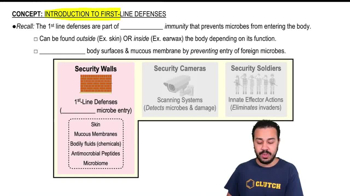
Innate defenses are the body's first line of defense against pathogens, present from birth. They provide a general, non-specific protection by recognizing common features of pathogens but do not target specific threats individually.
추천 영상:
First-Line Defenses
Adaptive Defenses
Adaptive defenses are specialized immune responses that develop after exposure to specific pathogens. They recognize and remember individual threats, allowing for targeted and more effective protection upon subsequent encounters.
추천 영상:
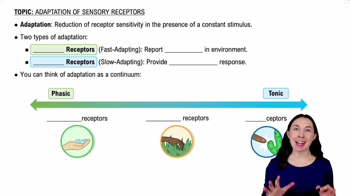
Adaptation
Specificity and Memory in Immunity
Adaptive immunity is characterized by its ability to distinguish between different pathogens and remember them. This specificity enables the immune system to mount a tailored response to each threat and improve defense over time.
추천 영상:
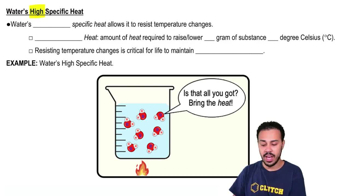
Water’s High Specific Heat
관련 실천
교과서 질문
1259
views
교과서 질문
Blocking the antigen receptors on the surface of lymphocytes would interfere with
(a) Phagocytosis of the antigen
(b) That lymphocyte's ability to produce antibodies
(c) Antigen recognition
(d) The ability of the lymphocyte to present antigen
(e) Opsonization of the antigen
1377
views
교과서 질문
What seven defenses, present at birth, provide the body with the defensive capability known as innate (nonspecific) immunity?
1168
views
교과서 질문
Compare and contrast the effects of complement with those of interferon.
1022
views
교과서 질문
Give a function for each of the following:
(a) Cytotoxic T cells
(b) Helper T cells
(c) Regulatory T cells
(d) Plasma cells
(e) NK cells
1085
views
교과서 질문
What are the three classes of lymphocytes, and where does each class originate?
1266
views