Ch. 27 Fluids & Electrolytes
Martini - Fundamentals of Anatomy and Physiology 12th Edition
Martini, Nath, Bartholomew12th EditionFundamentals of Anatomy and PhysiologyISBN: 9780137854011당신이 사용하는 게 아니라요?교과서 변경
26장, 문제 13

When the pH of body fluids begins to decrease, free amino acids and proteins will 
(a) Release a hydrogen from the carboxyl group
(b) Release a hydrogen from the amino group
(c) Release a hydrogen at the carboxyl group
(d) Bind a hydrogen at the amino group

검증된 단계별 안내
1
Understand that pH is a measure of hydrogen ion (H\(\textsuperscript{+}\)) concentration, and a decrease in pH means an increase in H\(\textsuperscript{+}\) concentration, making the environment more acidic.
Recall that amino acids and proteins have both amino (\-NH\(\textsubscript{2}\)) and carboxyl (\-COOH) groups, which can act as acids or bases depending on the pH of the environment.
At lower pH (more acidic), amino groups tend to accept hydrogen ions (H\(\textsuperscript{+}\)), becoming positively charged (\-NH\(\textsubscript{3}\)\(\textsuperscript{+}\)), while carboxyl groups tend to remain protonated (\-COOH) and do not release hydrogen ions.
Therefore, when body fluid pH decreases, free amino acids and proteins are more likely to bind hydrogen ions at the amino group rather than releasing hydrogen ions from either group.
Conclude that the correct response is that amino acids and proteins bind a hydrogen at the amino group in response to decreasing pH.

비슷한 문제에 대한 검증된 영상 답변:

이 영상 해법은 위 문제에 도움이 된다고 튜터들이 추천한 것입니다.
도움이 되었나요?

주요 개념

질문에 올바르게 답하기 위해 반드시 이해해야 하는 핵심 개념들은 다음과 같습니다.

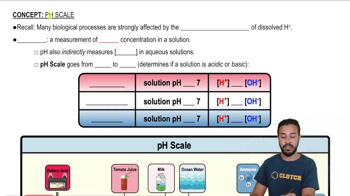
pH and Body Fluid Acidity

pH measures the acidity or alkalinity of a solution; a decrease in pH means the environment becomes more acidic with more free hydrogen ions (H+). Body fluids maintain a narrow pH range to ensure proper biochemical function, and changes in pH affect the ionization state of molecules like amino acids and proteins.
추천 영상:
07:58
pH Scale

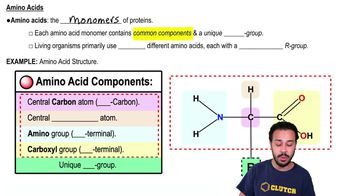
Ionizable Groups in Amino Acids and Proteins

Amino acids and proteins contain ionizable groups, mainly the amino (-NH2) and carboxyl (-COOH) groups. These groups can either release or bind hydrogen ions depending on the pH, influencing the molecule's charge and structure. The carboxyl group typically releases H+ in basic conditions, while the amino group can bind H+ in acidic conditions.
추천 영상:
04:37
Amino Acids

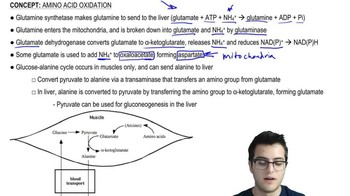
Buffering Role of Amino Acids and Proteins

Amino acids and proteins act as buffers by accepting or donating hydrogen ions to resist pH changes. When pH decreases (more acidic), amino groups tend to bind free hydrogen ions to minimize acidity, helping maintain pH balance in body fluids. This buffering capacity is crucial for physiological stability.
추천 영상:
11:42
Amino Acid Oxidation 2