뒤로
뒤로
문제 10.2.17
13–52. Limits of sequences
Find the limit of the following sequences or determine that the sequence diverges.
{tan⁻¹(10n⁄(10n + 4))}
문제 10.4.9
9–16. Divergence Test Use the Divergence Test to determine whether the following series diverge or state that the test is inconclusive.
∑ (k = 0 to ∞) k / (2k + 1)
문제 10.4.57
48–63. Choose your test Determine whether the following series converge or diverge using the properties and tests introduced in Sections 10.3 and 10.4.
∑ (k = 1 to ∞) (5 / 6)⁻ᵏ
문제 10.2.65
55–70. More sequences
Find the limit of the following sequences or determine that the sequence diverges.
{cos n / n}
문제 10.5.53
40–62. Choose your test Use the test of your choice to determine whether the following series converge.
∑ (k = 1 to ∞) 1 / k^(1 + p), p > 0
문제 10.1.53
51–56. {Use of Tech} Recurrence relations Consider the following recurrence relations. Make a table with at least ten terms and determine a plausible limit of the sequence or state that the sequence diverges.
aₙ₊₁ = 4aₙ + 1 a₀ = 1
문제 10.6.63
45–63. Absolute and conditional convergence Determine whether the following series converge absolutely, converge conditionally, or diverge.
∑ (k = 1 to ∞) (−1)ᵏ⁺¹ · (k!) / (kᵏ) (Hint: Show that k! / kᵏ ≤ 2 / k², for k ≥ 3.)
문제 10.5.11
9–36. Comparison tests Use the Comparison Test or the Limit Comparison Test to determine whether the following series converge.
∑ (k = 1 to ∞) (k² − 1) / (k³ + 4)
문제 10.2.87
84–87. {Use of Tech} Sequences by recurrence relations
The following sequences, defined by a recurrence relation, are monotonic and bounded, and therefore converge by Theorem 10.5.
a. Examine the first three terms of the sequence to determine whether the sequence is nondecreasing or nonincreasing.
b. Use analytical methods to find the limit of the sequence.
{Use of Tech} aₙ₊₁ = √(2 + aₙ); a₀ = 3
문제 10.4.35
23–38. Divergence, Integral, and p-series Tests Use the Divergence Test, the Integral Test, or the p-series test to determine whether the following series converge.
∑ (k = 1 to ∞) (k / (k + 10))ᵏ
문제 10.2.55
55–70. More sequences
Find the limit of the following sequences or determine that the sequence diverges.
{(−1)ⁿ / 2ⁿ}
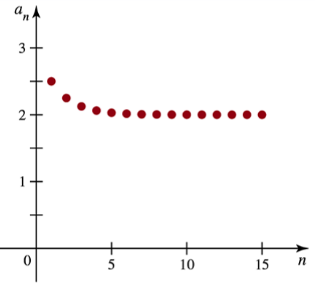
문제 10.1.49
49–50. Limits from graphs Consider the following sequences. Find the first four terms of the sequence .Based on part (a) and the figure, determine a plausible limit of the sequence.
aₙ = 2 + 2⁻ⁿ ; n = 1, 2, 3, …
문제 10.8.3
1–10. Choosing convergence tests Identify a convergence test for each series. If necessary, explain how to simplify or rewrite the series before applying the convergence test. You do not need to carry out the convergence test.
∑ (from k = 3 to ∞) (2k²) / (k² − k − 2)
문제 10.2.77
Growth rates of sequences
Use Theorem 10.6 to find the limit of the following sequences or state that they diverge.
{n¹⁰ / ln 20 n}
문제 10.8.79
11–86. Applying convergence tests Determine whether the following series converge. Justify your answers.
∑ (from k = 1 to ∞) tan⁻¹(1 / √k)
문제 10.2.41
13–52. Limits of sequences
Find the limit of the following sequences or determine that the sequence diverges.
{ⁿ√(e³ⁿ⁺⁴)}
문제 10.8.41
11–86. Applying convergence tests Determine whether the following series converge. Justify your answers.
∑ (from k = 1 to ∞) 2ᵏ / (3ᵏ − 2ᵏ)
문제 10.4.33
23–38. Divergence, Integral, and p-series Tests Use the Divergence Test, the Integral Test, or the p-series test to determine whether the following series converge.
∑ (k = 1 to ∞) k / eᵏ
문제 10.3.91
{Use of Tech} For what value of r does
∑ (k = 3 to ∞) r²ᵏ = 10?
문제 10.6.5
Explain why the magnitude of the remainder in an alternating series (with terms that are nonincreasing in magnitude) is less than or equal to the magnitude of the first neglected term.
문제 10.2.67
55–70. More sequences
Find the limit of the following sequences or determine that the sequence diverges.
{sin n / 2ⁿ}
문제 10.3.23
21–42. Geometric series Evaluate each geometric series or state that it diverges.
23. ∑ (k = 0 to ∞) (–9/10)ᵏ
문제 10.7.7
What test is advisable if a series involves a factorial term?
문제 10.3.21
21–42. Geometric series Evaluate each geometric series or state that it diverges.
21. ∑ (k = 0 to ∞) (1/4)ᵏ
문제 10.4.7
Define the remainder of an infinite series.
문제 10.7.41
32–49. Choose your test Use the test of your choice to determine whether the following series converge absolutely, converge conditionally, or diverge.
∑ (from k = 1 to ∞) (√k / k − 1)²ᵏ
문제 10.8.67
11–86. Applying convergence tests Determine whether the following series converge. Justify your answers.
∑ (from j = 1 to ∞) cot(–1 / j) / 2ʲ
문제 10.7.11
9–30. The Ratio and Root Tests Use the Ratio Test or the Root Test to determine whether the following series converge absolutely or diverge.
∑ (from k = 1 to ∞) ((-1)ᵏ⁺¹) × ((10k³ + k) / (9k³ + k + 1))ᵏ
문제 10.8.35
11–86. Applying convergence tests Determine whether the following series converge. Justify your answers.
∑ (from k = 1 to ∞) 2⁹k / kᵏ
문제 10.6.51
45–63. Absolute and conditional convergence Determine whether the following series converge absolutely, converge conditionally, or diverge.
∑ (k = 1 to ∞) cos(k) / k³