뒤로
뒤로
문제 101
Solve each equation.
문제 1
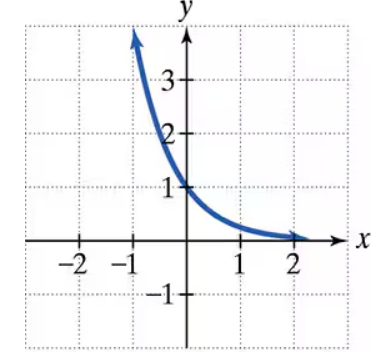
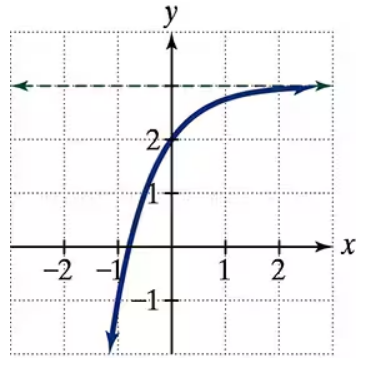
The graph of an exponential function is given. Select the function for each graph from the following options: f(x) = 4x, g(x) = 4-x, h(x) = -4-x, r(x) = -4-x+3
문제 3
The graph of an exponential function is given. Select the function for each graph from the following options: f(x) = 4x, g(x) = 4-x, h(x) = -4-x, r(x) = -4-x+3
문제 7
In Exercises 5–9, graph f and g in the same rectangular coordinate system. Use transformations of the graph of f to obtain the graph of g. Graph and give equations of all asymptotes. Use the graphs to determine each function's domain and range. f(x) = 3x and g(x) = -3x
문제 9
In Exercises 5–9, graph f and g in the same rectangular coordinate system. Use transformations of the graph of f to obtain the graph of g. Graph and give equations of all asymptotes. Use the graphs to determine each function's domain and range. f(x) = ex and g(x) = 2ex/2
문제 10
Use the compound interest formulas to solve Exercises 10–11. Suppose that you have $5000 to invest. Which investment yields the greater return over 5 years: 1.5% compounded semiannually or 1.45% compounded monthly?
문제 15
Write each equation in its equivalent exponential form. log3 81 = y
문제 25
In Exercises 19–29, evaluate each expression without using a calculator. If evaluation is not possible, state the reason. ln e5
문제 33
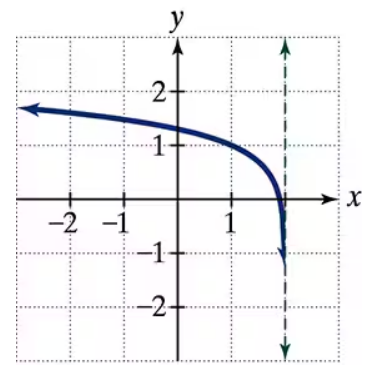
In Exercises 32–35, the graph of a logarithmic function is given. Select the function for each graph from the following options: f(x) = log x, g(x) = log(-x), h(x) = log(2-x), r(x)= 1+log(2-x)
문제 39
In Exercises 39–40, graph f and g in the same rectangular coordinate system. Use transformations of the graph of f to obtain the graph of g. Graph and give equations of all asymptotes. Use the graphs to determine each function's domain and range. f(x) = log x and g(x) = - log (x+3)
문제 51
In Exercises 50–53, use properties of logarithms to expand each logarithmic expression as much as possible. Where possible, evaluate logarithmic expressions without using a calculator.
문제 53
In Exercises 50–53, use properties of logarithms to expand each logarithmic expression as much as possible. Where possible, evaluate logarithmic expressions without using a calculator.
문제 55
In Exercises 54–57, use properties of logarithms to condense each logarithmic expression. Write the expression as a single logarithm whose coefficient is .
문제 57
Use properties of logarithms to condense each logarithmic expression. Write the expression as a single logarithm whose coefficient is 1. (1/2)ln x - ln y
문제 59
In Exercises 58–59, use common logarithms or natural logarithms and a calculator to evaluate to four decimal places. log4 0.863
문제 68
In Exercises 64–73, solve each exponential equation. Where necessary, express the solution set in terms of natural or common logarithms and use a calculator to obtain a decimal approximation, correct to two decimal places, for the solution.
문제 79
In Exercises 74–79, solve each logarithmic equation. log4 (2x+1) = log4 (x-3) + log4 (x+5)