
Ch.11 - Liquids and Intermolecular Forces
Brown - Chemistry: The Central Science 14th Edition
Brown14th EditionChemistry: The Central ScienceISBN: 9780134414232당신이 사용하는 게 아니라요?교과서 변경
11장, 문제 82

One of the attractive features of ionic liquids is their low vapor pressure, which in turn tends to make them nonflammable. Why do you think ionic liquids have lower vapor pressures than most room-temperature molecular liquids?

검증된 단계별 안내
1
Step 1: Understand the nature of ionic liquids. Ionic liquids are composed of ions, which are charged particles. These ions are held together by strong electrostatic forces known as ionic bonds.
Step 2: Compare the forces in ionic liquids to those in molecular liquids. In molecular liquids, the molecules are held together by weaker intermolecular forces such as hydrogen bonds, dipole-dipole interactions, or London dispersion forces.
Step 3: Consider the energy required to vaporize the liquid. For a liquid to vaporize, the particles must overcome the forces holding them together. Since ionic bonds are much stronger than the intermolecular forces in molecular liquids, more energy is required to vaporize ionic liquids.
Step 4: Relate the energy requirement to vapor pressure. Vapor pressure is a measure of a liquid's tendency to evaporate. Because ionic liquids require more energy to overcome their strong ionic bonds, they have a lower tendency to evaporate, resulting in a lower vapor pressure.
Step 5: Conclude with the implications of low vapor pressure. The low vapor pressure of ionic liquids contributes to their nonflammability, as there are fewer vapor molecules available to ignite.

주요 개념

질문에 올바르게 답하기 위해 반드시 이해해야 하는 핵심 개념들은 다음과 같습니다.

Ionic Liquids

Ionic liquids are salts that are liquid at room temperature, composed entirely of ions. Their unique structure, which includes large, asymmetric cations and anions, leads to strong electrostatic interactions. This results in a high degree of ion pairing and limited molecular mobility, contributing to their distinctive properties, such as low vapor pressure.
추천 영상:

Vapor Pressure

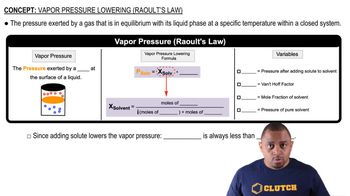
Vapor pressure is the pressure exerted by a vapor in equilibrium with its liquid or solid phase at a given temperature. It reflects the tendency of molecules to escape from the liquid phase into the gas phase. Substances with strong intermolecular forces, like ionic liquids, have lower vapor pressures because more energy is required to overcome these forces and allow molecules to vaporize.
추천 영상:
가이드 코스
02:40
Raoult's Law and Vapor Pressure

Intermolecular Forces

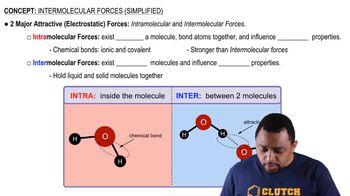
Intermolecular forces are the forces of attraction or repulsion between neighboring particles (atoms, molecules, or ions). In ionic liquids, the strong ionic bonds and interactions between charged particles create significant forces that hold the liquid together. This results in lower volatility compared to molecular liquids, where weaker van der Waals forces allow for easier vaporization.
추천 영상:
가이드 코스
01:59
Intermolecular vs Intramolecular Forces