Ch.2 - Atoms, Molecules & Ions
McMurry - Chemistry 8th Edition
McMurry8th EditionChemistryISBN: 9781292336145당신이 사용하는 게 아니라요?교과서 변경
2장, 문제 86

The results from Thomson’s cathode-ray tube experiment led to the discovery of which subatomic particle?

검증된 단계별 안내
1
Step 1: Understand the context of Thomson's experiment. J.J. Thomson conducted experiments using a cathode-ray tube, which is a sealed glass tube from which most of the air has been evacuated.
Step 2: Recognize the setup of the experiment. In the cathode-ray tube, a high voltage is applied across two electrodes, creating a beam of particles (cathode rays) that travel from the cathode (negative electrode) to the anode (positive electrode).
Step 3: Observe the behavior of the cathode rays. Thomson noticed that the rays were deflected by electric and magnetic fields, indicating that they were charged particles.
Step 4: Analyze the deflection of the rays. The direction of deflection suggested that the particles were negatively charged.
Step 5: Conclude the discovery. From these observations, Thomson concluded that the cathode rays were composed of negatively charged particles, which he called 'corpuscles,' later known as electrons, thus discovering the electron as a subatomic particle.

주요 개념

질문에 올바르게 답하기 위해 반드시 이해해야 하는 핵심 개념들은 다음과 같습니다.

Cathode Ray Experiment

Thomson's cathode-ray tube experiment involved passing an electric current through a vacuum tube, which produced rays that could be deflected by electric and magnetic fields. This setup allowed Thomson to investigate the properties of these rays, leading to significant insights about their nature and composition.
추천 영상:
가이드 코스
02:37
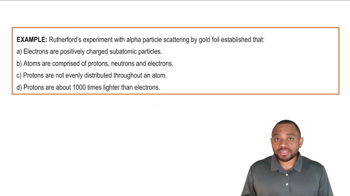
Rutherford Experiment Example

Subatomic Particles

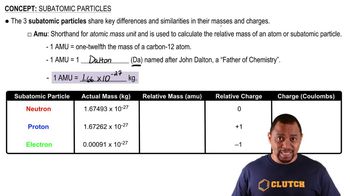
Subatomic particles are the fundamental constituents of atoms, including protons, neutrons, and electrons. Understanding these particles is crucial for grasping atomic structure and behavior, as they determine the chemical properties of elements and their interactions.
추천 영상:
가이드 코스
05:19
Subatomic Particles

Discovery of the Electron

Thomson's experiments concluded that cathode rays were composed of negatively charged particles, which he named electrons. This discovery was pivotal in the field of atomic physics, as it challenged the existing models of the atom and laid the groundwork for modern atomic theory.
추천 영상:
가이드 코스
04:44
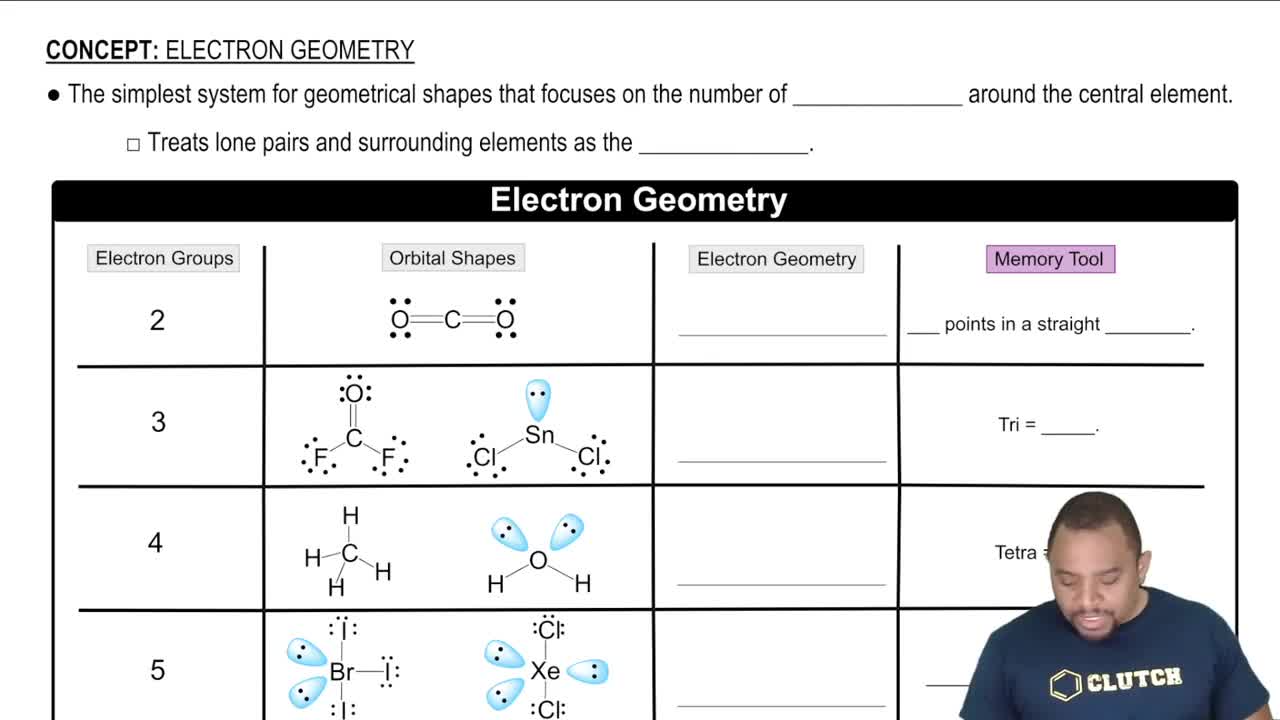
Electron Geometry