In a transformation experiment, donor DNA was obtained from a prototroph bacterial strain (a⁺b⁺c⁺), and the recipient was a triple auxotroph (a⁻b⁻c⁻). What general conclusions can you draw about the linkage relationships among the three genes from the following transformant classes that were recovered?

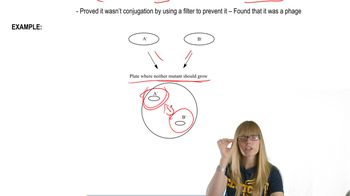
Explain the observations that led Zinder and Lederberg to conclude that the prototrophs recovered in their transduction experiments were not the result of F⁺ mediated conjugation.
검증된 단계별 안내
비슷한 문제에 대한 검증된 영상 답변:
주요 개념
Bacterial Conjugation and F⁺ Factor
Transduction as a Mechanism of Gene Transfer
Experimental Evidence Differentiating Transduction from Conjugation
Define plaque, lysogeny, and prophage.
Two theoretical genetic strains of a virus (a⁻b⁻c⁻ and a⁺b⁺c⁺) were used to simultaneously infect a culture of host bacteria. Of 10,000 plaques scored, the following genotypes were observed. Determine the genetic map of these three genes on the viral chromosome. Decide whether the interference was positive or negative.
The bacteriophage genome consists of many genes encoding proteins that make up the head, collar, tail, and tail fibers. When these genes are transcribed following phage infection, how are these proteins synthesized, since the phage genome lacks genes essential to ribosome structure?
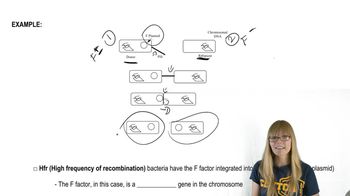
Describe the origin of F' bacteria and merozygotes.
Describe the role of heteroduplex formation during transformation.
