Ch. 11 - Gene Mutation, DNA Repair, and Homologous Recombination
Sanders - Genetic Analysis: An Integrated Approach 3rd Edition
Sanders3rd EditionGenetic Analysis: An Integrated ApproachISBN: 9780135564172당신이 사용하는 게 아니라요?교과서 변경
11장, 문제 10

In numerous population studies of spontaneous mutation, two observations are made consistently: (1) Most mutations are recessive, and (2) forward mutation is more frequent than reversion. What do you think are the likely explanations for these two observations?

검증된 단계별 안내
1
span>Step 1: Understand the nature of recessive mutations. Recessive mutations often result in a loss of function of a gene product. Since most genes are present in two copies (alleles), the presence of one normal (dominant) allele can often compensate for the loss of function in the mutated allele, making the mutation recessive.
span>Step 2: Consider the genetic redundancy and buffering. Many organisms have genetic redundancy, where multiple genes can perform similar functions. This redundancy can buffer the effects of mutations, making them appear recessive.
span>Step 3: Explore the concept of forward mutation. Forward mutation refers to a change from a wild-type allele to a mutant allele. This is more common because there are many possible ways to disrupt a gene's function, leading to a mutant phenotype.
span>Step 4: Analyze the rarity of reversion mutations. Reversion, or back mutation, involves a change from a mutant allele back to the wild-type allele. This is less frequent because it requires a specific change that precisely restores the original sequence and function.
span>Step 5: Reflect on the implications of these observations. The prevalence of recessive mutations and the higher frequency of forward mutations suggest that genetic variation is often hidden in populations and that evolutionary change is more likely to occur through the accumulation of new mutations rather than the reversion of existing ones.

비슷한 문제에 대한 검증된 영상 답변:

이 영상 해법은 위 문제에 도움이 된다고 튜터들이 추천한 것입니다.
영상 길이:
2m

주요 개념

질문에 올바르게 답하기 위해 반드시 이해해야 하는 핵심 개념들은 다음과 같습니다.

Recessive Mutations

Recessive mutations are genetic changes that do not manifest in the phenotype unless an individual has two copies of the mutated allele. This means that if a mutation is recessive, it can be carried by heterozygous individuals without affecting their observable traits. This characteristic leads to a higher prevalence of recessive mutations in populations, as they can persist without being selected against.
추천 영상:
가이드 코스
04:46
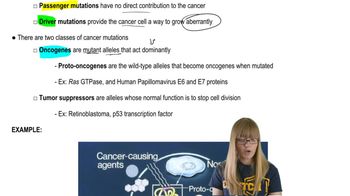
Cancer Mutations

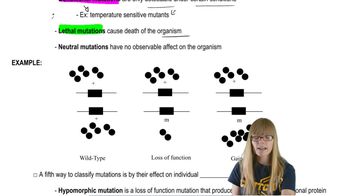
Forward Mutation vs. Reversion

Forward mutation refers to the process by which a normal gene is altered to a mutant form, while reversion is the process where a mutant gene returns to its original state. Forward mutations are generally more frequent than reversions due to the nature of genetic changes, where many factors such as environmental stressors and replication errors can induce new mutations, whereas reverting to the original state is a more specific and less likely event.
추천 영상:
가이드 코스
10:48
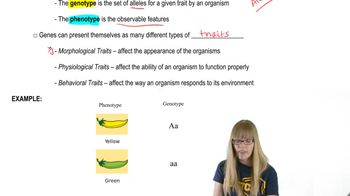
Mutations and Phenotypes

Population Genetics

Population genetics is the study of genetic variation within populations and how these variations change over time due to factors like mutation, selection, gene flow, and genetic drift. Understanding population genetics is crucial for interpreting mutation rates and patterns, as it provides insights into how mutations can affect allele frequencies and the overall genetic structure of populations.
추천 영상:
가이드 코스
03:45
Descriptive Genetics
관련 실천
교과서 질문

Two different mutations are identified in a haploid strain of yeast. The first prevents the synthesis of adenine by a nonsense mutation of the ade-1 gene. In this mutation, a base-pair substitution changes a tryptophan codon (UGG) to a stop codon (UGA). The second affects one of several duplicate tRNA genes. This base-pair substitution mutation changes the anticodon sequence of a tRNAᵀʳᵖ from


   3′−ACC−5′ to 3′−ACU−5′


Assuming there are no other mutations in the genome, will this double-mutant yeast strain be able to grow on minimal medium? If growth will occur, characterize the nature of growth relative to wild type.

493
views
교과서 질문

Two different mutations are identified in a haploid strain of yeast. The first prevents the synthesis of adenine by a nonsense mutation of the ade-1 gene. In this mutation, a base-pair substitution changes a tryptophan codon (UGG) to a stop codon (UGA). The second affects one of several duplicate tRNA genes. This base-pair substitution mutation changes the anticodon sequence of a tRNAᵀʳᵖ from


   3′−ACC−5′ to 3′−ACU−5′


Do you consider the first mutation to be a forward mutation or a reversion? Why?

470
views
교과서 질문

Two different mutations are identified in a haploid strain of yeast. The first prevents the synthesis of adenine by a nonsense mutation of the ade-1 gene. In this mutation, a base-pair substitution changes a tryptophan codon (UGG) to a stop codon (UGA). The second affects one of several duplicate tRNA genes. This base-pair substitution mutation changes the anticodon sequence of a tRNAᵀʳᵖ from


   3′−ACC−5′ to 3′−ACU−5′


Do you consider the second mutation to be a forward mutation or a reversion? Why?

523
views
교과서 질문

Researchers interested in studying mutation and mutation repair often induce mutations with various agents. What kinds of gene mutations are induced by

Radiation energy? Give two examples.

430
views
교과서 질문

Describe the purpose of the Ames test. How are his⁻ bacteria used in the Ames test? What mutational event is identified using his⁻ bacteria?

603
views
교과서 질문

The effect of base-pair substitution mutations on protein function varies widely from no detectable effect to the complete loss of protein function (null allele). Why do the functional consequences of base-pair substitution vary so widely?

607
views