The inheritance of certain mutations of BRCA1 can make it much more likely that a woman will develop breast or ovarian cancer in her lifetime. Can you say with certainty that a woman inheriting a mutation of BRCA1 will definitely develop breast or ovarian cancer in her lifetime? Why or why not?
Ch. 14 - Analysis of Gene Function via Forward Genetics and Reverse Genetics

모든 교과서
Sanders 3rd Edition
Ch. 14 - Analysis of Gene Function via Forward Genetics and Reverse Genetics
문제 C.7b
Sanders 3rd Edition
Ch. 14 - Analysis of Gene Function via Forward Genetics and Reverse Genetics
문제 C.7b14장, 문제 C.7b
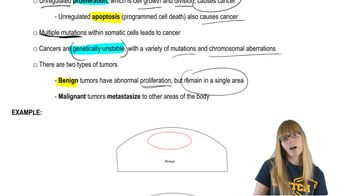
Why do most cancers require the mutation of multiple genes?
검증된 단계별 안내1
Understand that cancer is a complex disease characterized by uncontrolled cell growth and division, which results from genetic mutations affecting cellular functions.
Recognize that multiple genes are involved in regulating cell cycle, DNA repair, apoptosis (programmed cell death), and other critical cellular processes that maintain normal cell behavior.
Identify that mutations in a single gene are often insufficient to cause cancer because cells have redundant and overlapping mechanisms to prevent abnormal growth.
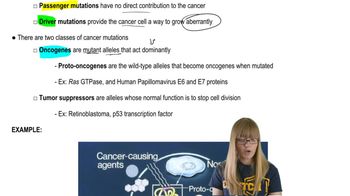
Learn that for a cell to become cancerous, mutations typically need to accumulate in several key types of genes, such as oncogenes (which promote cell division when activated) and tumor suppressor genes (which inhibit cell division or promote apoptosis when functioning properly).
Conclude that the requirement for multiple gene mutations arises because cancer development involves overcoming multiple cellular safeguards, and only the combined effect of these mutations leads to the loss of normal growth control.

비슷한 문제에 대한 검증된 영상 답변:
이 영상 해법은 위 문제에 도움이 된다고 튜터들이 추천한 것입니다.
영상 길이:
1m도움이 되었나요?
주요 개념
질문에 올바르게 답하기 위해 반드시 이해해야 하는 핵심 개념들은 다음과 같습니다.
Multistep Nature of Cancer Development
Cancer typically arises through a series of genetic changes rather than a single mutation. Multiple mutations accumulate over time, each contributing to the transformation of normal cells into malignant ones by disrupting various cellular processes.
추천 영상:
가이드 코스
Cancer Characteristics
Oncogenes and Tumor Suppressor Genes
Cancer involves mutations in oncogenes, which promote cell growth, and tumor suppressor genes, which inhibit growth or repair DNA. Both types of genes must be altered to override normal cell regulation and allow uncontrolled proliferation.
추천 영상:
가이드 코스
Mapping Genes
Genetic Instability and Mutation Accumulation
Genetic instability in cells increases mutation rates, enabling the accumulation of multiple gene mutations. This instability is crucial for cancer progression, as it allows cells to acquire the diverse mutations needed to evade growth controls and resist cell death.
추천 영상:
가이드 코스
Cancer Mutations
관련 실천
교과서 질문
452
views
교과서 질문
Based on what you read in this chapter, Can a tumor arise from a single mutated cell? Are all the cells in a tumor identical?
493
views
교과서 질문
Do you think it is important that participation in community-based genetic screening be entirely voluntary? Why or why not?
481
views
교과서 질문
Diagram the mechanism by which CRISPR–Cas functions in the immune system of bacteria and archaea.
668
views
교과서 질문
Describe how CRISPR–Cas has been modified to create a genome-editing tool.
724
views
교과서 질문
Radiation is frequently used as part of the treatment of cancer. The radiation works by damaging DNA and components of the cell. How can radiation treatment control or cure cancer?
597
views