Go to the website http://www.cancer.gov and select 'Cancer Types' on the top menu bar. Scroll down to 'Breast Cancer' and click. Select 'Cases & Prevention' from the options. Click 'More information' and select 'BRCA Mutations: Cancer Risk and Genetic Testing'. Use the information on this page to answer the following questions. With regard to the results of genetic testing for BRCA1 and BRCA2 mutations, what is meant by a 'positive result'?
Ch. 14 - Analysis of Gene Function via Forward Genetics and Reverse Genetics

모든 교과서
Sanders 3rd Edition
Ch. 14 - Analysis of Gene Function via Forward Genetics and Reverse Genetics
문제 C.8a
Sanders 3rd Edition
Ch. 14 - Analysis of Gene Function via Forward Genetics and Reverse Genetics
문제 C.8a14장, 문제 C.8a
The inheritance of certain mutations of BRCA1 can make it much more likely that a woman will develop breast or ovarian cancer in her lifetime. Can you say with certainty that a woman inheriting a mutation of BRCA1 will definitely develop breast or ovarian cancer in her lifetime? Why or why not?
검증된 단계별 안내1
Understand that inheriting a mutation in the BRCA1 gene increases the risk of developing breast or ovarian cancer, but it does not guarantee that cancer will develop. This is because BRCA1 mutations are considered risk factors, not deterministic causes.
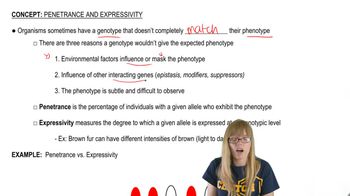
Recognize the concept of penetrance in genetics, which refers to the proportion of individuals with a particular genetic mutation who actually express the associated trait or disease. BRCA1 mutations have incomplete penetrance.
Consider environmental factors, lifestyle, and other genetic factors that can influence whether a woman with a BRCA1 mutation will develop cancer. These factors interact with the mutation to affect cancer risk.
Note that genetic counseling and testing provide probabilities or risk assessments rather than certainties, reflecting the complex nature of gene-environment interactions.
Summarize that while a BRCA1 mutation significantly raises the likelihood of cancer, it is not a definitive predictor, so a woman inheriting the mutation may or may not develop breast or ovarian cancer during her lifetime.

비슷한 문제에 대한 검증된 영상 답변:
이 영상 해법은 위 문제에 도움이 된다고 튜터들이 추천한 것입니다.
영상 길이:
2m도움이 되었나요?
주요 개념
질문에 올바르게 답하기 위해 반드시 이해해야 하는 핵심 개념들은 다음과 같습니다.
BRCA1 Gene and Its Role
BRCA1 is a gene that produces proteins responsible for repairing DNA damage. Mutations in BRCA1 can impair this repair process, increasing the risk of developing breast and ovarian cancers. However, not all mutations have the same effect, and the presence of a mutation raises risk but does not guarantee cancer.
추천 영상:
가이드 코스
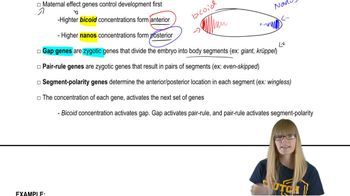
Segmentation Genes
Genetic Penetrance
Penetrance refers to the proportion of individuals with a specific genetic mutation who actually express the associated trait or disease. In the case of BRCA1 mutations, penetrance is incomplete, meaning some women with the mutation may never develop cancer, while others do, due to various genetic and environmental factors.
추천 영상:
가이드 코스
Penetrance and Expressivity
Risk Factors and Multifactorial Inheritance
Cancer development is influenced by multiple factors beyond a single gene mutation, including lifestyle, environment, and other genetic variations. Thus, inheriting a BRCA1 mutation increases risk but does not act alone, making cancer a multifactorial disease where risk is probabilistic, not deterministic.
추천 영상:
가이드 코스
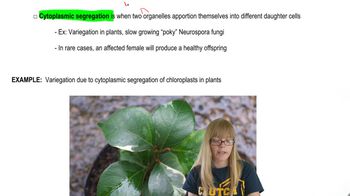
Organelle Inheritance
관련 실천
교과서 질문
410
views
교과서 질문
Discuss the advantages (and possible disadvantages) of the different approaches to reverse genetics.
611
views
교과서 질문
Do you think it is important that participation in community-based genetic screening be entirely voluntary? Why or why not?
481
views
교과서 질문
Why do most cancers require the mutation of multiple genes?
375
views
교과서 질문
Describe how CRISPR–Cas has been modified to create a genome-editing tool.
724
views
교과서 질문
The inheritance of certain mutations of BRCA1 can make it much more likely that a woman will develop breast or ovarian cancer in her lifetime. In addition to inheriting a BRCA1 mutation, what else must happen for a woman to develop breast or ovarian cancer?
387
views