Ch. 15 - Recombinant DNA Technology and Its Applications
Sanders - Genetic Analysis: An Integrated Approach 3rd Edition
Sanders3rd EditionGenetic Analysis: An Integrated ApproachISBN: 9780135564172당신이 사용하는 게 아니라요?교과서 변경
15장, 문제 E.4

What is the statistical principle underlying genetic health risk assessment? Why are these assessments not predictive of disease occurrence?

검증된 단계별 안내
1
Understand that genetic health risk assessment is based on the principle of probability and statistics, which estimate the likelihood of developing a disease based on the presence of certain genetic variants in a population.
Recognize that these assessments use data from population studies, such as genome-wide association studies (GWAS), to calculate risk scores by comparing the frequency of genetic markers in affected versus unaffected individuals.
Note that the risk provided is a statistical probability, not a certainty, because it reflects increased or decreased chances rather than a definitive outcome for an individual.
Consider that genetic risk assessments do not account for environmental factors, lifestyle, gene-gene interactions, and epigenetic modifications, all of which can influence whether a disease actually develops.
Conclude that because of the complex interplay between genes and other factors, genetic health risk assessments are useful for estimating risk but cannot predict with certainty if or when a disease will occur.

비슷한 문제에 대한 검증된 영상 답변:

이 영상 해법은 위 문제에 도움이 된다고 튜터들이 추천한 것입니다.
영상 길이:
2m
도움이 되었나요?

주요 개념

질문에 올바르게 답하기 위해 반드시 이해해야 하는 핵심 개념들은 다음과 같습니다.

Statistical Probability in Genetic Risk Assessment

Genetic health risk assessments use statistical probability to estimate the likelihood that an individual will develop a certain disease based on genetic variants. These probabilities are derived from population studies and reflect risk, not certainty, indicating how often a genetic variant is associated with disease occurrence.
추천 영상:

Multifactorial Nature of Disease

Most common diseases result from complex interactions between multiple genes and environmental factors. Because genetic variants are only one part of this interplay, genetic risk assessments cannot definitively predict disease but rather indicate increased or decreased risk.
추천 영상:
가이드 코스
05:54
Natural Selection

Penetrance and Expressivity

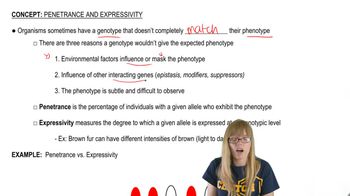
Penetrance refers to the proportion of individuals with a particular genetic variant who actually express the associated trait or disease, while expressivity describes the variability in symptoms. Incomplete penetrance and variable expressivity limit the predictive power of genetic risk assessments.
추천 영상:
가이드 코스
02:09
Penetrance and Expressivity
관련 실천
교과서 질문

Ligase catalyzes a reaction between the 5′ phosphate and the 3′ hydroxyl groups at the ends of DNA molecules. The enzyme calf intestinal phosphatase catalyzes the removal of the 5′5′ phosphate from DNA molecules. What would be the consequence of treating a cloning vector, before ligation, with calf intestinal phosphatase?

432
views
교과서 질문

You have constructed four different libraries: a genomic library made from DNA isolated from human brain tissue, a genomic library made from DNA isolated from human muscle tissue, a human brain cDNA library, and a human muscle cDNA library.

Which of these would have the greatest diversity of sequences?

833
views
교과서 질문

The human genome is 3×10⁹ bp in length.

How would your initial answer change if you knew that the average GC content of the human genome was 40%?

703
views
교과서 질문

Explain the meaning of 'identity by descent' in the context of identifying genealogical relationship between individuals. In these analyses, why are segments of chromosomes (haplotypes) rather than individual STRs used to identify genetic relationships?

668
views
교과서 질문

You have constructed four different libraries: a genomic library made from DNA isolated from human brain tissue, a genomic library made from DNA isolated from human muscle tissue, a human brain cDNA library, and a human muscle cDNA library.

Would the sequences contained in each library be expected to overlap completely, partially, or not at all with the sequences present in each of the other libraries?

517
views
교과서 질문

What is the exclusion principle? How is it used in forensic genetic analysis and in paternity determination?

678
views