Ch. 15 - Recombinant DNA Technology and Its Applications
Sanders - Genetic Analysis: An Integrated Approach 3rd Edition
Sanders3rd EditionGenetic Analysis: An Integrated ApproachISBN: 9780135564172당신이 사용하는 게 아니라요?교과서 변경
15장, 문제 34

Would a gene drive system spread rapidly through a population in a species that tends to self-mate (e.g., Arabidopsis, C. elegans)? In a species in which the breeding cycle is slow (e.g., humans)?

검증된 단계별 안내
1
Understand the concept of a gene drive system: A gene drive is a genetic engineering technology that promotes the inheritance of a particular gene to increase its prevalence in a population, even if it provides no selective advantage. It works by biasing the inheritance process during reproduction.
Consider the impact of self-mating species: In species that predominantly self-mate, such as Arabidopsis or C. elegans, genetic diversity is limited because offspring inherit nearly identical genetic material from the parent. Gene drives rely on heterozygosity (having different alleles at a locus) to spread effectively. Therefore, self-mating species may limit the efficiency of gene drive systems.
Analyze the breeding cycle speed: In species with slow breeding cycles, such as humans, the spread of a gene drive would be slower because fewer generations occur over a given time period. Gene drives rely on successive generations to propagate the engineered gene, so a slow breeding cycle would delay its spread.
Evaluate the interaction between mating system and breeding cycle: The effectiveness of a gene drive system depends on both the mating system and the breeding cycle. In self-mating species, the gene drive may struggle to spread due to limited genetic mixing. In species with slow breeding cycles, the spread would be delayed, but genetic mixing (e.g., sexual reproduction) could still facilitate its propagation over time.
Conclude with the implications for gene drive design: For self-mating species, alternative strategies such as targeting specific loci or using synthetic gene drives tailored to their reproductive biology may be necessary. For species with slow breeding cycles, long-term monitoring and modeling would be required to predict the spread and impact of the gene drive system.

비슷한 문제에 대한 검증된 영상 답변:

이 영상 해법은 위 문제에 도움이 된다고 튜터들이 추천한 것입니다.
영상 길이:
1m
도움이 되었나요?

주요 개념

질문에 올바르게 답하기 위해 반드시 이해해야 하는 핵심 개념들은 다음과 같습니다.

Gene Drive System

A gene drive system is a genetic engineering technology that promotes the inheritance of a particular gene to increase its prevalence in a population. This is achieved by biasing the normal Mendelian inheritance patterns, allowing the modified gene to be passed on to a greater proportion of offspring. Gene drives can be used for purposes such as controlling pest populations or spreading beneficial traits.
추천 영상:

Self-Mating and Reproductive Strategies

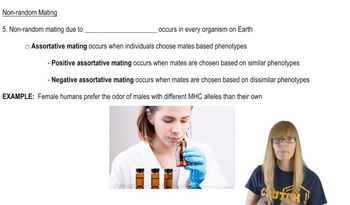
Self-mating, or self-fertilization, occurs when an organism fertilizes its own eggs, leading to reduced genetic diversity. In species like Arabidopsis and C. elegans, self-mating can facilitate the rapid spread of gene drives since the modified gene can be directly passed to all offspring. Understanding the reproductive strategy of a species is crucial for predicting how quickly a gene drive might disseminate within a population.
추천 영상:
가이드 코스
07:55
Non-Random Mating

Population Dynamics and Breeding Cycles

Population dynamics refers to the changes in population size and composition over time, influenced by factors such as reproduction rates and lifespan. In species with slow breeding cycles, like humans, the spread of a gene drive would be slower due to longer generation times and lower reproductive rates. This concept is essential for assessing the potential impact and effectiveness of gene drives in different species.
추천 영상:
가이드 코스
04:29
Bacteriophage Life Cycle