Identify and describe the evolutionary forces that can cause allele frequencies to change from one generation to the next.
Ch. 20 - Population Genetics and Evolution at the Population, Species, and Molecular Levels

모든 교과서
Sanders 3rd Edition
Ch. 20 - Population Genetics and Evolution at the Population, Species, and Molecular Levels
문제 4
Sanders 3rd Edition
Ch. 20 - Population Genetics and Evolution at the Population, Species, and Molecular Levels
문제 420장, 문제 4
Describe how natural selection can produce balanced polymorphism of allele frequencies through selection that favors heterozygotes.
검증된 단계별 안내1
Understand the concept of balanced polymorphism, which occurs when two or more alleles are maintained in a population's gene pool at stable frequencies over time.
Recognize that heterozygote advantage (also called overdominance) is a form of natural selection where individuals with heterozygous genotypes have higher fitness than either homozygous genotype.
Set up the fitness values for the three genotypes: let the fitness of homozygote AA be , heterozygote Aa be , and homozygote aa be , with and .
Use the concept that selection will increase the frequency of the heterozygote-favored allele combinations, but because both alleles contribute to heterozygotes, neither allele is lost, leading to a stable equilibrium of allele frequencies.
Explain that the equilibrium frequencies can be calculated by setting the change in allele frequency to zero and solving the equations derived from the relative fitness values, showing how natural selection maintains both alleles in the population.

비슷한 문제에 대한 검증된 영상 답변:
이 영상 해법은 위 문제에 도움이 된다고 튜터들이 추천한 것입니다.
영상 길이:
2m도움이 되었나요?
주요 개념
질문에 올바르게 답하기 위해 반드시 이해해야 하는 핵심 개념들은 다음과 같습니다.
Natural Selection
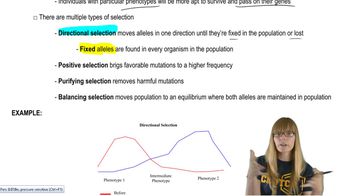
Natural selection is the process where individuals with traits better suited to their environment have higher survival and reproductive success. Over time, this leads to changes in allele frequencies within a population, favoring alleles that confer a fitness advantage.
추천 영상:
가이드 코스
Natural Selection
Balanced Polymorphism
Balanced polymorphism occurs when two or more alleles are maintained in a population at stable frequencies due to selective advantages. This genetic diversity persists because heterozygotes have higher fitness than either homozygote, preventing any single allele from becoming fixed or lost.
추천 영상:
가이드 코스
Aneuploidy
Heterozygote Advantage
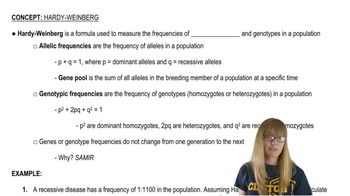
Heterozygote advantage is a form of selection where individuals with two different alleles (heterozygotes) have greater fitness than those with two identical alleles (homozygotes). This advantage maintains multiple alleles in the gene pool, as seen in cases like sickle cell trait providing malaria resistance.
추천 영상:
가이드 코스
Hardy Weinberg
관련 실천
교과서 질문
483
views
교과서 질문
Discuss how both gains and losses of regulatory elements may lead to human-specific traits.
486
views
교과서 질문
How do copy-number variants arise? Do they account for more polymorphism than SNPs within the human population?
514
views
교과서 질문
Thinking creatively about evolutionary mechanisms, identify at least two schemes that could generate allelic polymorphism in a population. Do not include the processes described in the answer to Problem 4.
459
views
교과서 질문
What lines of evidence support the hypothesis that modern humans evolved in Africa and then subsequently migrated throughout the globe?
576
views
교과서 질문
What insights have analyses of human mitochondrial DNA provided into our recent evolutionary past?
874
views