Ch. 20 - Population Genetics and Evolution at the Population, Species, and Molecular Levels
Sanders - Genetic Analysis: An Integrated Approach 3rd Edition
Sanders3rd EditionGenetic Analysis: An Integrated ApproachISBN: 9780135564172당신이 사용하는 게 아니라요?교과서 변경
20장, 문제 D.5

How do copy-number variants arise? Do they account for more polymorphism than SNPs within the human population?

검증된 단계별 안내
1
Understand what copy-number variants (CNVs) are: CNVs are segments of DNA that are duplicated or deleted, resulting in a variable number of copies of that segment between individuals in a population.
Learn the mechanisms by which CNVs arise: CNVs typically arise through errors during DNA replication or repair, such as non-allelic homologous recombination (NAHR), non-homologous end joining (NHEJ), or replication fork stalling and template switching (FoSTeS).
Compare CNVs to single nucleotide polymorphisms (SNPs): SNPs are single base-pair changes in the DNA sequence, while CNVs involve larger segments of DNA that can range from kilobases to megabases in size.
Evaluate the contribution of CNVs to genetic polymorphism: Although SNPs are more numerous in terms of count, CNVs can affect larger portions of the genome and thus contribute more to the total amount of genetic variation between individuals.
Summarize the relative impact: CNVs account for a significant portion of genetic diversity and structural variation in the human genome, often exceeding the amount of polymorphism caused by SNPs when considering the total DNA sequence affected.

비슷한 문제에 대한 검증된 영상 답변:

이 영상 해법은 위 문제에 도움이 된다고 튜터들이 추천한 것입니다.
영상 길이:
2m
도움이 되었나요?

주요 개념

질문에 올바르게 답하기 위해 반드시 이해해야 하는 핵심 개념들은 다음과 같습니다.

Copy-Number Variants (CNVs)

CNVs are segments of DNA that vary in copy number between individuals, involving deletions or duplications of large genomic regions. They arise through mechanisms like unequal crossing over during meiosis, replication errors, or DNA repair processes, leading to structural variation in the genome.
추천 영상:
가이드 코스
08:42
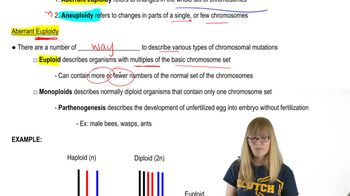
Aberrant Euploid

Single Nucleotide Polymorphisms (SNPs)

SNPs are the most common type of genetic variation, involving a change of a single nucleotide base in the DNA sequence. Although individually small, SNPs are abundant throughout the genome and serve as important markers for genetic diversity and association studies.
추천 영상:
가이드 코스
03:51
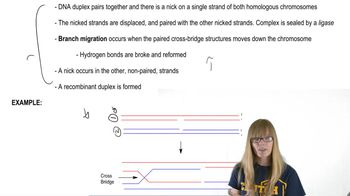
Recombination after Single Strand Breaks

Genetic Polymorphism and Variation

Genetic polymorphism refers to the presence of two or more variants (alleles) at a locus within a population. Understanding the relative contribution of CNVs and SNPs to polymorphism helps clarify the extent and impact of structural versus single-base genetic diversity in humans.
추천 영상:
가이드 코스
09:28
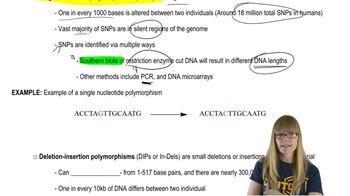
Genomic Variation