Genetic drift, an evolutionary process affecting all populations, can have a significant effect in small populations, even though its effect is negligible in large populations. Explain why this is the case.
Ch. 20 - Population Genetics and Evolution at the Population, Species, and Molecular Levels

모든 교과서
Sanders 3rd Edition
Ch. 20 - Population Genetics and Evolution at the Population, Species, and Molecular Levels
문제 5
Sanders 3rd Edition
Ch. 20 - Population Genetics and Evolution at the Population, Species, and Molecular Levels
문제 520장, 문제 5
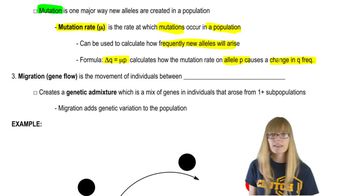
Thinking creatively about evolutionary mechanisms, identify at least two schemes that could generate allelic polymorphism in a population. Do not include the processes described in the answer to Problem 4.
검증된 단계별 안내1
Step 1: Understand the concept of allelic polymorphism, which refers to the presence of two or more alleles at a locus within a population, contributing to genetic diversity.
Step 2: Recall that evolutionary mechanisms generating allelic polymorphism include mutation, natural selection, gene flow, genetic drift, and recombination, but exclude those mentioned in Problem 4 as per the instructions.
Step 3: Consider mutation as one scheme: random changes in DNA sequences introduce new alleles into the population, increasing allelic variation over time.
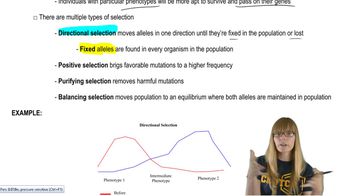
Step 4: Consider balancing selection as another scheme: this includes mechanisms like heterozygote advantage or frequency-dependent selection, which maintain multiple alleles in the population by favoring genetic diversity.
Step 5: Summarize that both mutation (introducing new alleles) and balancing selection (maintaining multiple alleles) are key evolutionary schemes that can generate and sustain allelic polymorphism in populations.

비슷한 문제에 대한 검증된 영상 답변:
이 영상 해법은 위 문제에 도움이 된다고 튜터들이 추천한 것입니다.
영상 길이:
2m도움이 되었나요?
주요 개념
질문에 올바르게 답하기 위해 반드시 이해해야 하는 핵심 개념들은 다음과 같습니다.
Allelic Polymorphism
Allelic polymorphism refers to the presence of two or more different alleles at a gene locus within a population. This genetic variation is essential for evolution and adaptation, as it provides the raw material for natural selection to act upon.
추천 영상:
가이드 코스
New Alleles and Migration
Balancing Selection
Balancing selection is an evolutionary mechanism that maintains multiple alleles in a population by providing a selective advantage to heterozygotes or through frequency-dependent selection. This process helps preserve genetic diversity and can generate stable allelic polymorphism.
추천 영상:
가이드 코스
Natural Selection
Mutation and Gene Flow
Mutation introduces new alleles into a population by altering DNA sequences, while gene flow involves the transfer of alleles between populations through migration. Both mechanisms increase genetic variation and can contribute to the generation and maintenance of allelic polymorphism.
추천 영상:
가이드 코스
Cancer Mutations
관련 실천
교과서 질문
764
views
교과서 질문
Discuss how both gains and losses of regulatory elements may lead to human-specific traits.
486
views
교과서 질문
Consider possible societal and ethical dilemmas that might arise if we currently shared the planet with another hominin.
529
views
교과서 질문
How do copy-number variants arise? Do they account for more polymorphism than SNPs within the human population?
514
views
교과서 질문
What lines of evidence support the hypothesis that modern humans evolved in Africa and then subsequently migrated throughout the globe?
576
views
교과서 질문
Describe how natural selection can produce balanced polymorphism of allele frequencies through selection that favors heterozygotes.
545
views