Ch. 5 - Genetic Linkage and Mapping in Eukaryotes
Sanders - Genetic Analysis: An Integrated Approach 3rd Edition
Sanders3rd EditionGenetic Analysis: An Integrated ApproachISBN: 9780135564172당신이 사용하는 게 아니라요?교과서 변경
5장, 문제 6c

In Drosophila, the map positions of genes are given in map units numbering from one end of a chromosome to the other. The X chromosome of Drosophila is 66 m.u. long. The X-linked gene for body color—with two alleles, y⁺ for gray body and y for yellow body—resides at one end of the chromosome at map position 0.0. A nearby locus for eye color, with alleles w⁺ for red eye and w for white eye, is located at map position 1.5. A third X-linked gene, controlling bristle form, with f⁺ for normal bristles and f for forked bristles, is located at map position 56.7. At each locus the wild-type allele is dominant over the mutant allele.


A wild-type female fruit fly with the genotype y⁺w⁺f/ywf⁺ is crossed to a male fruit fly that has yellow body, white eye, and forked bristles. Predict the frequency of each progeny phenotype class produced by this mating.

검증된 단계별 안내
1
Step 1: Understand the genetic setup. The female is heterozygous for all three loci (y⁺w⁺f/ywf⁺), while the male is hemizygous for the mutant alleles (ywf). Since these genes are X-linked, males inherit their X chromosome from their mother and their Y chromosome from their father, while females inherit one X chromosome from each parent.
Step 2: Determine the parental and recombinant gametes. The female can produce four types of gametes due to recombination: parental types (y⁺w⁺f and ywf⁺) and recombinant types (y⁺wf⁺ and ywf). The male can only produce one type of gamete (ywf) because he is hemizygous for the X chromosome.
Step 3: Calculate the recombination frequencies. Use the map distances to estimate the recombination frequencies between the loci. The distance between y and w is 1.5 m.u., corresponding to a 1.5% recombination frequency. The distance between w and f is 56.7 - 1.5 = 55.2 m.u., corresponding to a 55.2% recombination frequency. Assume that recombination events between y and f are independent.
Step 4: Predict the frequency of each gamete type. Use the recombination frequencies to calculate the proportion of parental and recombinant gametes. For example, the parental gametes (y⁺w⁺f and ywf⁺) will occur with a frequency of (1 - recombination frequency), while the recombinant gametes (y⁺wf⁺ and ywf) will occur with a frequency equal to the recombination frequency.
Step 5: Determine the progeny phenotypes and their frequencies. Combine the gametes from the female with the single type of gamete from the male (ywf). For each combination, determine the genotype and corresponding phenotype of the progeny. Multiply the frequency of the female gamete by the male gamete frequency to calculate the frequency of each progeny phenotype.

비슷한 문제에 대한 검증된 영상 답변:

이 영상 해법은 위 문제에 도움이 된다고 튜터들이 추천한 것입니다.
영상 길이:
2m
도움이 되었나요?

주요 개념

질문에 올바르게 답하기 위해 반드시 이해해야 하는 핵심 개념들은 다음과 같습니다.

Genetic Linkage

Genetic linkage refers to the tendency of genes located close to each other on a chromosome to be inherited together during meiosis. This is important in understanding the inheritance patterns of traits, as linked genes do not assort independently. In the context of the question, the proximity of the body color, eye color, and bristle form genes on the Drosophila X chromosome affects the expected phenotypic ratios in the offspring.
추천 영상:
가이드 코스
07:33
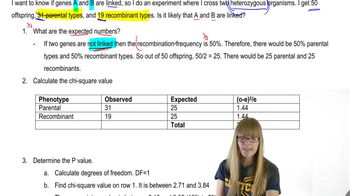
Chi Square and Linkage

Map Units and Recombination Frequency

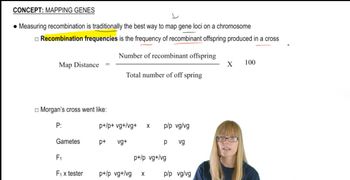
Map units (m.u.) are a measure of genetic distance between loci on a chromosome, where 1 m.u. corresponds to a 1% chance of recombination occurring between two genes during meiosis. The distances provided in the question indicate how likely it is for recombination to separate the alleles of the linked genes. Understanding these distances is crucial for predicting the phenotypic ratios of the progeny from the cross.
추천 영상:

Dominance and Allelic Interactions

Dominance describes the relationship between alleles of a gene, where the dominant allele masks the expression of the recessive allele in a heterozygous individual. In this scenario, the wild-type alleles (y⁺, w⁺, f⁺) are dominant over their respective mutant alleles (y, w, f). This concept is essential for determining the phenotypes of the progeny based on the genotypes of the parents in the cross.
추천 영상:
가이드 코스
04:37
Variations on Dominance
관련 실천
교과서 질문

Gene G recombines with gene T at a frequency of 7%, and gene G recombines with gene R at a frequency of 4%.


Draw two possible genetic maps for these three genes, and identify the recombination frequencies predicted for each map.

498
views
교과서 질문

In tomato plants, purple leaf color is controlled by a dominant allele A, and green leaf by a recessive allele a. At another locus, hairy leaf H is dominant to hairless leaf h. The genes for leaf color and leaf texture are separated by 16 m.u. on chromosome 5. On chromosome 4, a gene controlling leaf shape has two alleles: a dominant allele C that produces cut-leaf shape and a recessive allele c that produces potato-shaped leaves.

Fully explain the number and frequency of each phenotype class.

509
views
교과서 질문

In Drosophila, the map positions of genes are given in map units numbering from one end of a chromosome to the other. The X chromosome of Drosophila is 66 m.u. long. The X-linked gene for body color—with two alleles, y⁺ for gray body and y for yellow body—resides at one end of the chromosome at map position 0.0. A nearby locus for eye color, with alleles w⁺ for red eye and w for white eye, is located at map position 1.5. A third X-linked gene, controlling bristle form, with f⁺ for normal bristles and f for forked bristles, is located at map position 56.7. At each locus the wild-type allele is dominant over the mutant allele.


Explain how each of the predicted progeny classes is produced.

725
views
교과서 질문

Genes A, B, and C are linked on a chromosome and found in the order A–B–C. Genes A and B recombine with a frequency of 8%, and genes B and C recombine at a frequency of 24%. For the cross a⁺b⁺c/abc⁺ × abc/abc, predict the frequency of progeny genotypes. Assume interference is zero.

1179
views
교과서 질문

In Drosophila, the map positions of genes are given in map units numbering from one end of a chromosome to the other. The X chromosome of Drosophila is 66 m.u. long. The X-linked gene for body color—with two alleles, y⁺ for gray body and y for yellow body—resides at one end of the chromosome at map position 0.0. A nearby locus for eye color, with alleles w⁺ for red eye and w for white eye, is located at map position 1.5. A third X-linked gene, controlling bristle form, with f⁺ for normal bristles and f for forked bristles, is located at map position 56.7. At each locus the wild-type allele is dominant over the mutant allele.


In a cross involving these three X-linked genes, do you expect any gene pair(s) to show genetic linkage? Explain your reasoning.

572
views
교과서 질문

In Drosophila, the map positions of genes are given in map units numbering from one end of a chromosome to the other. The X chromosome of Drosophila is 66 m.u. long. The X-linked gene for body color—with two alleles, y⁺ for gray body and y for yellow body—resides at one end of the chromosome at map position 0.0. A nearby locus for eye color, with alleles w⁺ for red eye and w for white eye, is located at map position 1.5. A third X-linked gene, controlling bristle form, with f⁺ for normal bristles and f for forked bristles, is located at map position 56.7. At each locus the wild-type allele is dominant over the mutant allele.


Do you expect any of these gene pair(s) to assort independently? Explain your reasoning.

424
views