Ch. 5 - Genetic Linkage and Mapping in Eukaryotes
Sanders - Genetic Analysis: An Integrated Approach 3rd Edition
Sanders3rd EditionGenetic Analysis: An Integrated ApproachISBN: 9780135564172당신이 사용하는 게 아니라요?교과서 변경
5장, 문제 6d

In Drosophila, the map positions of genes are given in map units numbering from one end of a chromosome to the other. The X chromosome of Drosophila is 66 m.u. long. The X-linked gene for body color—with two alleles, y⁺ for gray body and y for yellow body—resides at one end of the chromosome at map position 0.0. A nearby locus for eye color, with alleles w⁺ for red eye and w for white eye, is located at map position 1.5. A third X-linked gene, controlling bristle form, with f⁺ for normal bristles and f for forked bristles, is located at map position 56.7. At each locus the wild-type allele is dominant over the mutant allele.


Explain how each of the predicted progeny classes is produced.

검증된 단계별 안내
1
Understand the genetic setup: The problem involves three X-linked genes in Drosophila, each with a wild-type (dominant) and mutant (recessive) allele. The genes are located at specific map positions on the X chromosome: y⁺/y (body color) at 0.0 m.u., w⁺/w (eye color) at 1.5 m.u., and f⁺/f (bristle form) at 56.7 m.u.
Recognize the concept of recombination: The map positions indicate the likelihood of crossing over between genes during meiosis. The farther apart two genes are, the higher the probability of recombination between them. For example, y and w are close (1.5 m.u. apart), so recombination between them is rare, while y and f are far apart (56.7 m.u.), making recombination more likely.
Determine the parental and recombinant gametes: Parental gametes retain the original combinations of alleles (e.g., y⁺w⁺f⁺ or ywf), while recombinant gametes result from crossing over (e.g., y⁺wf or yw⁺f⁺). The frequency of each gamete type depends on the recombination rates derived from the map distances.
Predict progeny classes: The progeny classes are determined by the combinations of gametes from the parents. For example, if a heterozygous female (y⁺w⁺f/ywf) is crossed with a hemizygous male (ywf), the offspring will inherit one X chromosome from the mother and one from the father. The specific combinations of alleles in the progeny depend on whether the maternal gamete is parental or recombinant.
Explain the production of each progeny class: Parental progeny classes (e.g., y⁺w⁺f and ywf) result from gametes without crossing over, while recombinant progeny classes (e.g., y⁺wf or yw⁺f⁺) result from crossing over events. The relative frequencies of these classes reflect the map distances between the genes, with closer genes producing fewer recombinants and farther-apart genes producing more recombinants.

비슷한 문제에 대한 검증된 영상 답변:

이 영상 해법은 위 문제에 도움이 된다고 튜터들이 추천한 것입니다.
영상 길이:
1m
도움이 되었나요?

주요 개념

질문에 올바르게 답하기 위해 반드시 이해해야 하는 핵심 개념들은 다음과 같습니다.

Genetic Linkage

Genetic linkage refers to the tendency of genes located close to each other on a chromosome to be inherited together during meiosis. This is due to their physical proximity, which reduces the likelihood of recombination occurring between them. In the context of Drosophila, the proximity of the body color gene to the eye color gene suggests that they may be inherited together more frequently than genes that are farther apart, such as the bristle form gene.
추천 영상:
가이드 코스
07:33
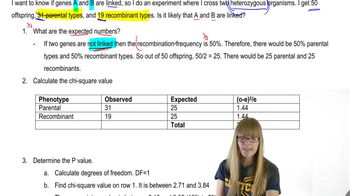
Chi Square and Linkage

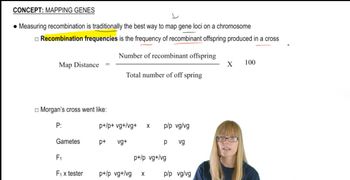
Map Units and Recombination Frequency

Map units, or centimorgans (cM), are a measure of genetic distance based on the frequency of recombination between loci during meiosis. One map unit corresponds to a 1% chance of recombination occurring between two genes. In the given Drosophila example, the distances between the body color and eye color genes (1.5 m.u.) and the bristle form gene (56.7 m.u.) indicate how likely these genes are to be separated during gamete formation, influencing the expected progeny classes.
추천 영상:

Dominance and Allelic Interactions

Dominance describes the relationship between alleles of a gene, where the presence of a dominant allele masks the expression of a recessive allele. In the Drosophila example, the wild-type alleles (y⁺, w⁺, f⁺) are dominant over their respective mutant alleles (y, w, f). This dominance affects the phenotypic ratios of the progeny, as the combination of alleles inherited from the parents will determine the observable traits in the offspring.
추천 영상:
가이드 코스
04:37
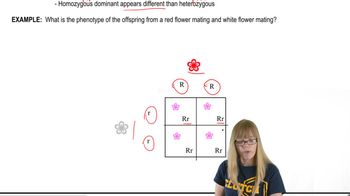
Variations on Dominance
관련 실천
교과서 질문

Gene G recombines with gene T at a frequency of 7%, and gene G recombines with gene R at a frequency of 4%.


Draw two possible genetic maps for these three genes, and identify the recombination frequencies predicted for each map.

498
views
교과서 질문

Genes A, B, and C are linked on a chromosome and found in the order A–B–C. Genes A and B recombine with a frequency of 8%, and genes B and C recombine at a frequency of 24%. For the cross a⁺b⁺c/abc⁺ × abc/abc, predict the frequency of progeny genotypes. Assume interference is zero.

1179
views
교과서 질문

In Drosophila, the map positions of genes are given in map units numbering from one end of a chromosome to the other. The X chromosome of Drosophila is 66 m.u. long. The X-linked gene for body color—with two alleles, y⁺ for gray body and y for yellow body—resides at one end of the chromosome at map position 0.0. A nearby locus for eye color, with alleles w⁺ for red eye and w for white eye, is located at map position 1.5. A third X-linked gene, controlling bristle form, with f⁺ for normal bristles and f for forked bristles, is located at map position 56.7. At each locus the wild-type allele is dominant over the mutant allele.


In a cross involving these three X-linked genes, do you expect any gene pair(s) to show genetic linkage? Explain your reasoning.

572
views
교과서 질문

Gene G recombines with gene T at a frequency of 7%, and gene G recombines with gene R at a frequency of 4%.


Assuming that organisms with any desired genotype are available, propose a genetic cross whose result could be used to determine which of the proposed genetic maps is correct.

541
views
교과서 질문

In Drosophila, the map positions of genes are given in map units numbering from one end of a chromosome to the other. The X chromosome of Drosophila is 66 m.u. long. The X-linked gene for body color—with two alleles, y⁺ for gray body and y for yellow body—resides at one end of the chromosome at map position 0.0. A nearby locus for eye color, with alleles w⁺ for red eye and w for white eye, is located at map position 1.5. A third X-linked gene, controlling bristle form, with f⁺ for normal bristles and f for forked bristles, is located at map position 56.7. At each locus the wild-type allele is dominant over the mutant allele.


Do you expect any of these gene pair(s) to assort independently? Explain your reasoning.

424
views
교과서 질문

In Drosophila, the map positions of genes are given in map units numbering from one end of a chromosome to the other. The X chromosome of Drosophila is 66 m.u. long. The X-linked gene for body color—with two alleles, y⁺ for gray body and y for yellow body—resides at one end of the chromosome at map position 0.0. A nearby locus for eye color, with alleles w⁺ for red eye and w for white eye, is located at map position 1.5. A third X-linked gene, controlling bristle form, with f⁺ for normal bristles and f for forked bristles, is located at map position 56.7. At each locus the wild-type allele is dominant over the mutant allele.


A wild-type female fruit fly with the genotype y⁺w⁺f/ywf⁺ is crossed to a male fruit fly that has yellow body, white eye, and forked bristles. Predict the frequency of each progeny phenotype class produced by this mating.

544
views