
교과서 질문
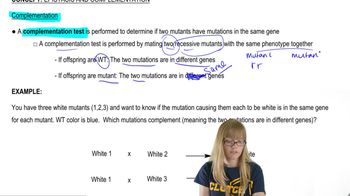
Define the term genetic complementation.
Give another example of genetic complementation and describe how genetic complementation works in that case.
597
views

 검증된 단계별 안내
 05:05
05:05
 03:38
03:38 05:02
05:02Define the term genetic complementation.
Give another example of genetic complementation and describe how genetic complementation works in that case.
The phage P1 is used as a generalized transducing phage in an experiment combining a donor strain of E. coli of genotype leu⁺ phe⁺ ala⁺ and a recipient strain that is leu⁻ phe⁻ ala⁻. In separate experiments, transductants are selected for leu⁺ (Experiment A), for ala⁺ (Experiment B), and for phe⁺ (Experiment C). Following selection, transductant genotypes for the unselected markers are identified. The selection experiment results below show the frequency of each genotype.
In Experiment B, why are there no transductants with the genotype leu⁻ ala⁺?
Define the term genetic complementation.
Describe how the term applies to an experiment in which two lysis-defective bacteriophages are able to coinfect a bacterial cell and produce lysis.
Devise an experiment to identify bacteria that are auxotrophic and unable to produce two amino acids, lysine (lys) and valine (val). The auxotrophic bacteria are in a pool of bacteria in which all the other bacteria are prototrophic. The genotype of the auxotrophs is lys⁻ val⁻. Describe each step in the experiment, identify the constituents in any growth medium or growth plates you propose, and identify the results that will conclusively identify bacteria that are lys⁻ val⁻.
The phage P1 is used as a generalized transducing phage in an experiment combining a donor strain of E. coli of genotype leu⁺ phe⁺ ala⁺ and a recipient strain that is leu⁻ phe⁻ ala⁻. In separate experiments, transductants are selected for leu⁺ (Experiment A), for ala⁺ (Experiment B), and for phe⁺ (Experiment C). Following selection, transductant genotypes for the unselected markers are identified. The selection experiment results below show the frequency of each genotype.
Determine the order of genes on the donor chromosome.
The phage P1 is used as a generalized transducing phage in an experiment combining a donor strain of E. coli of genotype leu⁺ phe⁺ ala⁺ and a recipient strain that is leu⁻ phe⁻ ala⁻. In separate experiments, transductants are selected for leu⁺ (Experiment A), for ala⁺ (Experiment B), and for phe⁺ (Experiment C). Following selection, transductant genotypes for the unselected markers are identified. The selection experiment results below show the frequency of each genotype.
Diagram the crossover events that form each of the transductants in Experiment A.