
- Ch. 1 - The Molecular Basis of Heredity, Variation, and Evolution64
- Ch. 2 - Transmission Genetics144
- Ch. 3 - Cell Division and Chromosome Heredity81
- Ch. 4 - Gene Interaction87
- Ch. 5 - Genetic Linkage and Mapping in Eukaryotes103
- Ch. 6 - Genetic Analysis and Mapping in Bacteria and Bacteriophages73
- Ch. 7 - DNA Structure and Replication71
- Ch. 8 - Molecular Biology of Transcription and RNA Processing79
- Ch. 9 - The Molecular Biology of Translation110
- Ch. 10 - Eukaryotic Chromosome Abnormalities and Molecular Organization100
- Ch. 11 - Gene Mutation, DNA Repair, and Homologous Recombination86
- Ch. 12 - Regulation of Gene Expression in Bacteria and Bacteriophage90
- Ch. 13 - Regulation of Gene Expression in Eukaryotes38
- Ch. 14 - Analysis of Gene Function via Forward Genetics and Reverse Genetics72
- Ch. 15 - Recombinant DNA Technology and Its Applications69
- Ch. 16 - Genomics: Genetics from a Whole-Genome Perspective49
- Ch. 17 - Organelle Inheritance and the Evolution of Organelle Genomes27
- Ch. 18 - Developmental Genetics43
- Ch. 19 - Genetic Analysis of Quantitative Traits66
- Ch. 20 - Population Genetics and Evolution at the Population, Species, and Molecular Levels105

Define the term genetic complementation.
Give another example of genetic complementation and describe how genetic complementation works in that case.
 검증된 단계별 안내
비슷한 문제에 대한 검증된 영상 답변:

주요 개념
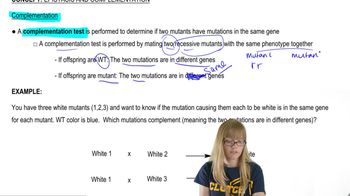
Genetic Complementation
 05:05
05:05
Complementation Test
05:05Examples of Genetic Complementation
05:05Fifty bacterial colonies are on a complete-medium growth plate. The colonies are replica plated to a minimal-medium plate, and 46 colonies grow. What can you say about the bacteria from the four colonies that do not grow? Design an experiment and describe the methods you would use to determine if any of these four colonies are leu⁻, arg⁻, or val⁻.
Look closely at the consolidated Hfr map and the data used to build the map on page 261. Suppose a fifth Hfr strain had the F factor inserted exactly halfway between cysE and leuU and had an orientation that was the same as that of Hfr 1. List the order of gene transfer for the first six genes transferred by this Hfr and the number of minutes of conjugation at which each gene is expected to be seen.
The phage P1 is used as a generalized transducing phage in an experiment combining a donor strain of E. coli of genotype leu⁺ phe⁺ ala⁺ and a recipient strain that is leu⁻ phe⁻ ala⁻. In separate experiments, transductants are selected for leu⁺ (Experiment A), for ala⁺ (Experiment B), and for phe⁺ (Experiment C). Following selection, transductant genotypes for the unselected markers are identified. The selection experiment results below show the frequency of each genotype.
In Experiment B, why are there no transductants with the genotype leu⁻ ala⁺?
Define the term genetic complementation.
Describe how the term applies to an experiment in which two lysis-defective bacteriophages are able to coinfect a bacterial cell and produce lysis.
Devise an experiment to identify bacteria that are auxotrophic and unable to produce two amino acids, lysine (lys) and valine (val). The auxotrophic bacteria are in a pool of bacteria in which all the other bacteria are prototrophic. The genotype of the auxotrophs is lys⁻ val⁻. Describe each step in the experiment, identify the constituents in any growth medium or growth plates you propose, and identify the results that will conclusively identify bacteria that are lys⁻ val⁻.