Ch. 6 - Genetic Analysis and Mapping in Bacteria and Bacteriophages
Sanders - Genetic Analysis: An Integrated Approach 3rd Edition
Sanders3rd EditionGenetic Analysis: An Integrated ApproachISBN: 9780135564172당신이 사용하는 게 아니라요?교과서 변경
6장, 문제 7

Describe what is meant by the term site-specific recombination as used in identifying the processes that lead to the integration of temperate bacteriophages into host bacterial chromosomes during lysogeny or to the formation of specialized transducing phage.

검증된 단계별 안내
1
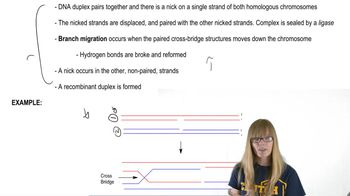
Site-specific recombination refers to a type of genetic recombination where DNA strand exchange occurs at specific sequences, rather than randomly across the genome.
In the context of temperate bacteriophages, site-specific recombination is the process by which the phage DNA integrates into the host bacterial chromosome during lysogeny. This integration is mediated by specific recombination sites on both the phage DNA and the bacterial chromosome.
The integration process involves enzymes called recombinases, such as integrase, which recognize and catalyze the recombination between the specific sequences on the phage and host DNA.
During the formation of specialized transducing phages, site-specific recombination can lead to the excision of the prophage (integrated phage DNA) from the bacterial chromosome. If this excision is imprecise, it may include adjacent bacterial genes, which are then packaged into the phage particle.
This process is significant because it allows for the horizontal transfer of bacterial genes, contributing to genetic diversity and the spread of traits such as antibiotic resistance among bacterial populations.

비슷한 문제에 대한 검증된 영상 답변:

이 영상 해법은 위 문제에 도움이 된다고 튜터들이 추천한 것입니다.
영상 길이:
1m
도움이 되었나요?

주요 개념

질문에 올바르게 답하기 위해 반드시 이해해야 하는 핵심 개념들은 다음과 같습니다.

Site-Specific Recombination

Site-specific recombination is a genetic process where DNA segments are exchanged at specific sequences, allowing for the integration of foreign DNA into a host genome. This mechanism is crucial for the stable incorporation of temperate bacteriophages into bacterial chromosomes during lysogeny, enabling the phage to coexist with the host without causing immediate lysis.
추천 영상:
가이드 코스
03:51
Recombination after Single Strand Breaks

Lysogeny

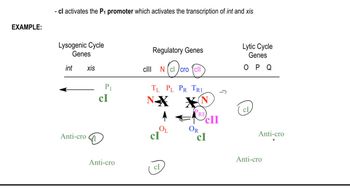
Lysogeny is a viral life cycle phase where a temperate bacteriophage integrates its genome into the host bacterial chromosome, forming a prophage. This integration allows the phage to replicate along with the host's DNA during cell division, leading to a stable relationship until conditions trigger the lytic cycle, where the phage becomes active and produces new virions.
추천 영상:
가이드 코스
08:04
Decision Between Lytic and Lysogenic Cycles

Specialized Transduction

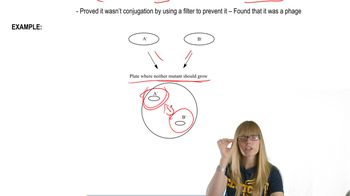
Specialized transduction is a process where a bacteriophage transfers specific bacterial genes from one host to another during the lysogenic cycle. This occurs when a prophage incorrectly excises from the bacterial chromosome, taking adjacent bacterial genes with it, which can then be introduced into a new bacterial host, facilitating genetic diversity and evolution.
추천 영상: