Ch. 7 - DNA Structure and Replication
Sanders - Genetic Analysis: An Integrated Approach 3rd Edition
Sanders3rd EditionGenetic Analysis: An Integrated ApproachISBN: 9780135564172당신이 사용하는 게 아니라요?교과서 변경
7장, 문제 8d

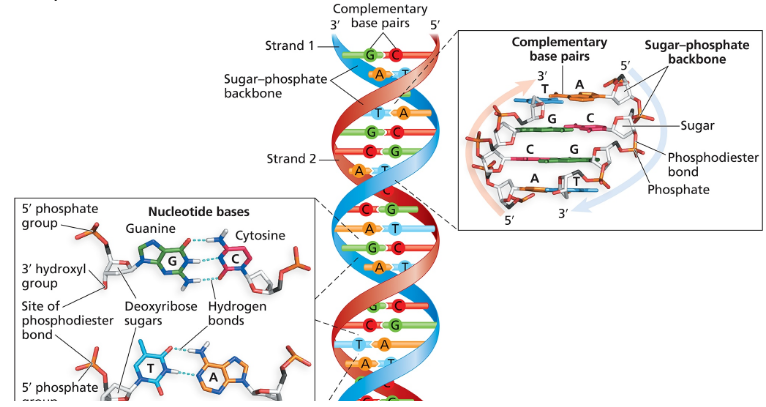
The following figure (Figure 1.6) presents simplified depictions of nucleotides containing deoxyribose, a nucleotide base, and a phosphate group. Use this simplified method of representation to illustrate the sequence 3'-AGTCGAT-5' and its complementary partner in a DNA duplex.
Illustration of DNA structure showing nucleotide bases, sugar-phosphate backbone, and hydrogen bonds in base pairs.
How many hydrogen bonds are present in this DNA duplex?

검증된 단계별 안내
1
Step 1: Understand the structure of DNA. DNA is a double-stranded molecule where each strand is composed of nucleotides. Each nucleotide consists of three components: a deoxyribose sugar, a phosphate group, and a nitrogenous base (adenine (A), thymine (T), guanine (G), or cytosine (C)). The two strands are complementary and antiparallel, meaning one strand runs 5' to 3' while the other runs 3' to 5'.
Step 2: Write the given sequence 3'-AGTCGAT-5' in the correct orientation. Since the sequence is provided in the 3' to 5' direction, you can directly use it as the template strand.
Step 3: Determine the complementary strand. Use the base-pairing rules: adenine (A) pairs with thymine (T) via two hydrogen bonds, and guanine (G) pairs with cytosine (C) via three hydrogen bonds. Write the complementary strand in the 5' to 3' direction, ensuring the antiparallel orientation.
Step 4: Count the hydrogen bonds. For each A-T pair, there are 2 hydrogen bonds, and for each G-C pair, there are 3 hydrogen bonds. Identify the number of A-T and G-C pairs in the sequence and calculate the total number of hydrogen bonds.
Step 5: Verify your work. Double-check the complementary strand for correct base pairing and antiparallel orientation. Ensure the total hydrogen bond count matches the number of base pairs in the DNA duplex.

비슷한 문제에 대한 검증된 영상 답변:

이 영상 해법은 위 문제에 도움이 된다고 튜터들이 추천한 것입니다.
영상 길이:
1m
도움이 되었나요?

주요 개념

질문에 올바르게 답하기 위해 반드시 이해해야 하는 핵심 개념들은 다음과 같습니다.

Nucleotides

Nucleotides are the building blocks of DNA and RNA, consisting of three components: a sugar (deoxyribose in DNA), a phosphate group, and a nitrogenous base. The sequence of these bases encodes genetic information. In DNA, the four types of nitrogenous bases are adenine (A), thymine (T), cytosine (C), and guanine (G). Understanding the structure of nucleotides is essential for analyzing DNA sequences.
추천 영상:

Complementary Base Pairing

In DNA, complementary base pairing refers to the specific pairing of nitrogenous bases across the two strands of the double helix. Adenine pairs with thymine (A-T) through two hydrogen bonds, while cytosine pairs with guanine (C-G) through three hydrogen bonds. This pairing is crucial for the stability of the DNA structure and for accurate DNA replication and transcription.
추천 영상:
가이드 코스
03:49
Base Distortions

Hydrogen Bonds in DNA

Hydrogen bonds are weak interactions that occur between the nitrogenous bases of the two DNA strands, contributing to the overall stability of the DNA double helix. Each A-T pair forms two hydrogen bonds, while each C-G pair forms three. The total number of hydrogen bonds in a DNA duplex can be calculated by analyzing the base pairs in the given sequence and their complements.
추천 영상:
관련 실천
교과서 질문

The following figure (Figure 1.6) presents simplified depictions of nucleotides containing deoxyribose, a nucleotide base, and a phosphate group. Use this simplified method of representation to illustrate the sequence 3'-AGTCGAT-5' and its complementary partner in a DNA duplex.

What kind of bonds join the C in one strand to the G in the complementary strand?

488
views
교과서 질문

Consider the sequence 3'-ACGCTACGTC-5'.

What is the double-stranded sequence?

661
views
교과서 질문

Consider the sequence 3'-ACGCTACGTC-5'.

What is the total number of noncovalent bonds joining the nucleotides of the complementary strands?

595
views
교과서 질문

The following figure (Figure 1.6) presents simplified depictions of nucleotides containing deoxyribose, a nucleotide base, and a phosphate group. Use this simplified method of representation to illustrate the sequence 3'-AGTCGAT-5' and its complementary partner in a DNA duplex.

How many phosphodiester bonds are present in this DNA duplex?

425
views
교과서 질문

Consider the sequence 3'-ACGCTACGTC-5'.

What is the total number of covalent bonds joining the nucleotides in each strand?

943
views
교과서 질문

The following figure (Figure 1.6) presents simplified depictions of nucleotides containing deoxyribose, a nucleotide base, and a phosphate group. Use this simplified method of representation to illustrate the sequence 3'-AGTCGAT-5' and its complementary partner in a DNA duplex.

What kind of bond joins the C to G within a single strand?

438
views