Ch. 7 - DNA Structure and Replication
Sanders - Genetic Analysis: An Integrated Approach 3rd Edition
Sanders3rd EditionGenetic Analysis: An Integrated ApproachISBN: 9780135564172당신이 사용하는 게 아니라요?교과서 변경
7장, 문제 9c

Consider the sequence 3'-ACGCTACGTC-5'.
What is the total number of noncovalent bonds joining the nucleotides of the complementary strands?

검증된 단계별 안내
1
Step 1: Understand the problem. The sequence provided is 3'-ACGCTACGTC-5'. To determine the total number of noncovalent bonds, we need to identify the complementary strand and count the hydrogen bonds between the base pairs.
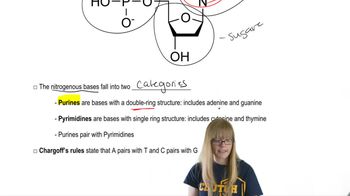
Step 2: Recall the base pairing rules in DNA. Adenine (A) pairs with Thymine (T) via 2 hydrogen bonds, and Cytosine (C) pairs with Guanine (G) via 3 hydrogen bonds.
Step 3: Write the complementary strand for the given sequence. The complementary strand will be 5'-TGCGATGCAG-3', as each base pairs with its complement.
Step 4: Count the hydrogen bonds for each base pair. For example, A-T pairs contribute 2 hydrogen bonds, and C-G pairs contribute 3 hydrogen bonds. Sum the hydrogen bonds for all base pairs in the sequence.
Step 5: Add the total number of hydrogen bonds from all base pairs to determine the total number of noncovalent bonds joining the nucleotides of the complementary strands.

비슷한 문제에 대한 검증된 영상 답변:

이 영상 해법은 위 문제에 도움이 된다고 튜터들이 추천한 것입니다.
영상 길이:
2m
도움이 되었나요?

주요 개념

질문에 올바르게 답하기 위해 반드시 이해해야 하는 핵심 개념들은 다음과 같습니다.

Base Pairing

Base pairing refers to the specific hydrogen bonding between nucleotide bases in DNA. Adenine pairs with thymine (A-T) through two hydrogen bonds, while cytosine pairs with guanine (C-G) through three hydrogen bonds. Understanding base pairing is essential for determining the number of noncovalent bonds in complementary strands.
추천 영상:
가이드 코스
03:49
Base Distortions

Nucleotide Structure

Nucleotides are the building blocks of DNA and consist of a phosphate group, a sugar (deoxyribose in DNA), and a nitrogenous base. The sequence of these nucleotides encodes genetic information. Recognizing the structure of nucleotides helps in identifying how they interact and bond with complementary nucleotides.
추천 영상:

Complementary Strands

Complementary strands in DNA refer to the two strands that run in opposite directions and are held together by hydrogen bonds between their base pairs. Each nucleotide on one strand pairs with a specific nucleotide on the opposite strand, which is crucial for the stability of the DNA double helix and for processes like replication and transcription.
추천 영상:
가이드 코스
03:03
Double Strand Breaks