Ch. 9 - The Molecular Biology of Translation
Sanders - Genetic Analysis: An Integrated Approach 3rd Edition
Sanders3rd EditionGenetic Analysis: An Integrated ApproachISBN: 9780135564172당신이 사용하는 게 아니라요?교과서 변경
9장, 문제 20b

Describe the roles and relationships between tRNA anticodon sequences and mRNA codon sequences.

검증된 단계별 안내
1
Understand the structure of mRNA codons: mRNA is composed of nucleotide sequences organized into codons, which are groups of three nucleotides. Each codon corresponds to a specific amino acid or a stop signal during translation.
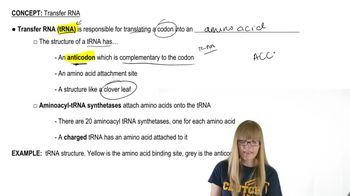
Learn the structure of tRNA: Transfer RNA (tRNA) molecules have an anticodon region that consists of three nucleotides complementary to the mRNA codon. This allows tRNA to recognize and bind to the correct codon on the mRNA strand.
Explore the base-pairing rules: The anticodon on tRNA pairs with the mRNA codon through complementary base pairing. For example, adenine (A) pairs with uracil (U), and cytosine (C) pairs with guanine (G). This ensures accurate translation of the genetic code.
Understand the role of tRNA in translation: tRNA carries specific amino acids to the ribosome. When the anticodon of tRNA binds to the corresponding mRNA codon, the ribosome facilitates the addition of the amino acid to the growing polypeptide chain.
Recognize the importance of codon-anticodon interaction: The precise pairing between mRNA codons and tRNA anticodons ensures that the correct sequence of amino acids is assembled, which is critical for producing functional proteins.

비슷한 문제에 대한 검증된 영상 답변:

이 영상 해법은 위 문제에 도움이 된다고 튜터들이 추천한 것입니다.
영상 길이:
3m

주요 개념

질문에 올바르게 답하기 위해 반드시 이해해야 하는 핵심 개념들은 다음과 같습니다.

tRNA and Anticodons

Transfer RNA (tRNA) is a type of RNA molecule that helps decode mRNA sequences into proteins. Each tRNA molecule has a specific three-nucleotide sequence called an anticodon, which is complementary to a corresponding codon on the mRNA. This complementary pairing ensures that the correct amino acid is added to the growing polypeptide chain during protein synthesis.
추천 영상:

mRNA and Codons

Messenger RNA (mRNA) is a single-stranded RNA that carries genetic information from DNA to the ribosome, where proteins are synthesized. The mRNA is read in sets of three nucleotides known as codons, each of which specifies a particular amino acid. The sequence of codons in mRNA determines the order of amino acids in a protein, which is crucial for its function.
추천 영상:
가이드 코스
08:39
mRNA Processing

Translation Process

Translation is the process by which the genetic code carried by mRNA is translated into a sequence of amino acids to form a protein. During translation, ribosomes facilitate the binding of tRNA anticodons to mRNA codons, ensuring that the correct amino acids are linked together in the proper order. This process is essential for gene expression and the synthesis of functional proteins.
추천 영상:
가이드 코스
08:39
mRNA Processing