Ch. 9 - The Molecular Biology of Translation
Sanders - Genetic Analysis: An Integrated Approach 3rd Edition
Sanders3rd EditionGenetic Analysis: An Integrated ApproachISBN: 9780135564172당신이 사용하는 게 아니라요?교과서 변경
9장, 문제 20a

Describe the roles and relationships between tRNA synthetases and tRNA molecules.

검증된 단계별 안내
1
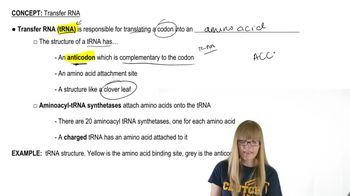
Understand that tRNA (transfer RNA) molecules are responsible for carrying specific amino acids to the ribosome during protein synthesis, where they match their anticodon with the codon on mRNA.
Learn that tRNA synthetases, also known as aminoacyl-tRNA synthetases, are enzymes that play a critical role in attaching the correct amino acid to its corresponding tRNA molecule. This process is called 'tRNA charging' or 'aminoacylation.'
Recognize that each tRNA synthetase is specific to one amino acid and its corresponding tRNA(s). There are 20 different tRNA synthetases, one for each amino acid.
Explore the two-step process of aminoacylation: (1) The tRNA synthetase activates the amino acid by attaching it to an adenosine monophosphate (AMP) molecule, forming an aminoacyl-AMP intermediate. (2) The activated amino acid is then transferred to the 3' end of the tRNA molecule, forming an aminoacyl-tRNA.
Understand the importance of the specificity of tRNA synthetases, as errors in attaching the wrong amino acid to a tRNA can lead to the incorporation of incorrect amino acids into proteins, potentially disrupting their structure and function.

비슷한 문제에 대한 검증된 영상 답변:

이 영상 해법은 위 문제에 도움이 된다고 튜터들이 추천한 것입니다.
영상 길이:
2m

주요 개념

질문에 올바르게 답하기 위해 반드시 이해해야 하는 핵심 개념들은 다음과 같습니다.

tRNA Molecules

Transfer RNA (tRNA) molecules are essential components of the protein synthesis machinery in cells. They serve as adapters that translate the genetic code carried by messenger RNA (mRNA) into specific amino acids during translation. Each tRNA molecule has a specific anticodon that pairs with a corresponding codon on the mRNA, ensuring the correct amino acid is added to the growing polypeptide chain.
추천 영상:

tRNA Synthetases

tRNA synthetases are a group of enzymes responsible for charging tRNA molecules with their corresponding amino acids. Each synthetase is specific to one amino acid and its associated tRNA(s), ensuring that the correct amino acid is linked to the appropriate tRNA. This process, known as aminoacylation, is crucial for accurate protein synthesis, as it directly influences the fidelity of translation.
추천 영상:

Aminoacylation

Aminoacylation is the process by which an amino acid is covalently attached to its corresponding tRNA molecule by a tRNA synthetase. This reaction is vital for the translation process, as it activates the amino acid for incorporation into a polypeptide chain. The accuracy of aminoacylation is critical, as errors can lead to the incorporation of incorrect amino acids, potentially resulting in dysfunctional proteins.
추천 영상:
관련 실천
교과서 질문

In an experiment to decipher the genetic code, a poly-AC mRNA (ACACACAC...) is synthesized. What pattern of amino acids would appear if this sequence were to be translated by a mechanism that reads the genetic code as

A doublet with overlaps?

679
views
교과서 질문

Describe the roles and relationships between tRNA anticodon sequences and mRNA codon sequences.

850
views
교과서 질문

After completing Problem 17, carefully draw a line below the mRNA to represent its polypeptide product in accurate alignment with the mRNA. Label the N-terminal and C-terminal ends of the polypeptide. Carefully draw two lines above and parallel to the mRNA, and label them 'coding strand' and 'template strand.' Locate the DNA promoter sequence. Identify the locations of the  nucleotide and of a transcription termination sequence.

737
views
교과서 질문

In an experiment to decipher the genetic code, a poly-AC mRNA (ACACACAC...) is synthesized. What pattern of amino acids would appear if this sequence were to be translated by a mechanism that reads the genetic code as

A doublet without overlaps?

555
views
교과서 질문

The line below represents a mature eukaryotic mRNA. The accompanying list contains many sequences or structures that are part of eukaryotic mRNA. A few of the items in the list, however, are not found in eukaryotic mRNA. As accurately as you can, show the location, on the line, of the sequences or structures that belong in eukaryotic mRNA; then, separately, list the items that are not part of eukaryotic mRNA.
5′ ____________________________ 3′

a. stop codon
b. poly-A tail
c. intron
d. 3' UTR
e. promoter
f. start codon
g. AAUAAA
h. 5' UTR
i. 5' cap
j. termination sequence

852
views
교과서 질문

Define and describe the differences in the primary, secondary, and tertiary structures of a protein.

560
views