Ch.4 Introduction to Organic Compounds
Frost - General, Organic and Biological Chemistry 4th Edition
Frost4th EditionGeneral, Organic and Biological ChemistryISBN: 9780134988696당신이 사용하는 게 아니라요?교과서 변경
1장, 문제 84b

For each pair of molecules, identify the pair as:
A. structural isomers.
B. the same molecule (conformational isomers).
C. cis–trans stereoisomers.
D. different molecules.                                                                                                                                                                 
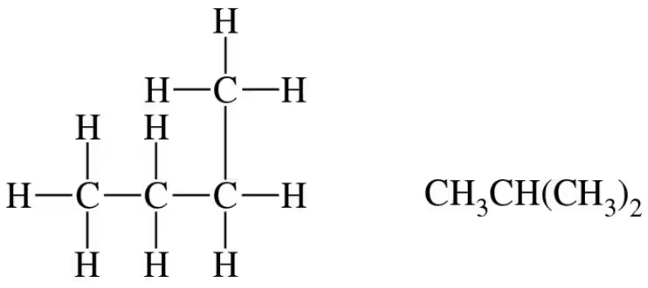
(b)

검증된 단계별 안내
1
Step 1: Understand the definitions of the terms provided in the problem: (A) Structural isomers are molecules with the same molecular formula but different connectivity of atoms. (B) The same molecule (conformational isomers) refers to molecules that are identical but differ in their spatial arrangement due to rotation around single bonds. (C) Cis–trans stereoisomers are molecules with the same connectivity but differ in spatial arrangement around a double bond or a ring structure. (D) Different molecules have different molecular formulas or connectivity.
Step 2: Analyze the molecular structures provided in the problem. Look for differences in molecular formula, connectivity, or spatial arrangement. If the molecular formula is different, the molecules are classified as 'different molecules' (D).
Step 3: If the molecular formula is the same, check the connectivity of the atoms. If the connectivity differs, the molecules are 'structural isomers' (A).
Step 4: If the connectivity is the same, examine the spatial arrangement. If the molecules differ in spatial arrangement around a double bond or ring structure, they are 'cis–trans stereoisomers' (C). If the spatial arrangement differs due to rotation around single bonds, they are 'the same molecule (conformational isomers)' (B).
Step 5: Based on the analysis, classify each pair of molecules into one of the four categories (A, B, C, or D). Ensure to carefully compare all aspects of the molecular structures to make an accurate classification.

비슷한 문제에 대한 검증된 영상 답변:

이 영상 해법은 위 문제에 도움이 된다고 튜터들이 추천한 것입니다.
영상 길이:
2m
도움이 되었나요?

주요 개념

질문에 올바르게 답하기 위해 반드시 이해해야 하는 핵심 개념들은 다음과 같습니다.

Structural Isomers

Structural isomers are compounds that have the same molecular formula but differ in the connectivity of their atoms. This means that the atoms are arranged in different ways, leading to distinct chemical properties and structures. For example, butane and isobutane are structural isomers, as they have the same formula (C4H10) but different arrangements of carbon atoms.
추천 영상:
가이드 코스
2:16
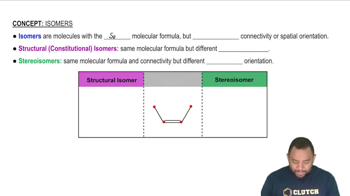
Isomers Concept 1

Conformational Isomers

Conformational isomers, also known as conformers, are different spatial arrangements of the same molecule that can be interconverted by rotation around single bonds. These isomers do not involve breaking any bonds and can often be visualized as different 'shapes' of the same molecule. An example is the staggered and eclipsed forms of ethane, which arise from the rotation around the C-C bond.
추천 영상:
가이드 코스
2:16
Isomers Concept 1

Cis-Trans Stereoisomers

Cis-trans stereoisomers are a type of geometric isomerism where the orientation of functional groups differs around a double bond or a ring structure. In cis isomers, similar groups are on the same side, while in trans isomers, they are on opposite sides. This difference can significantly affect the physical and chemical properties of the compounds, such as boiling points and solubility.
추천 영상:
가이드 코스
1:56
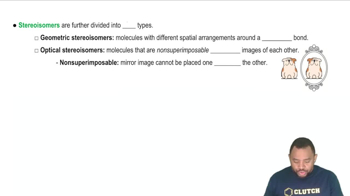
Stereoisomers Concept 2