Ch.4 Introduction to Organic Compounds
Frost - General, Organic and Biological Chemistry 4th Edition
Frost4th EditionGeneral, Organic and Biological ChemistryISBN: 9780134988696당신이 사용하는 게 아니라요?교과서 변경
1장, 문제 83

Certain omega-3 fatty acids can be found only in animal sources, such as fatty fish. Two of these are eicosapentaenoic acid (EPA) [20:5] and docosahexaenoic acid (DHA) [22:6], both of which are ω-3 fatty acids. DHA has been shown to be important in healthy brain development, so it has recently been added to infant formulas. Breast milk is rich in DHA as long as the mother maintains a healthy diet that includes fish. Draw skeletal structures of the fatty acids EPA and DHA.

검증된 단계별 안내
1
Understand the notation [20:5] and [22:6]. The first number represents the total number of carbon atoms in the fatty acid chain, and the second number represents the number of double bonds in the chain.
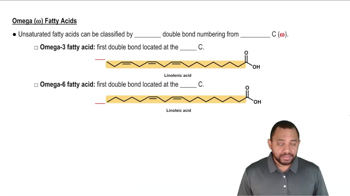
Recognize that these are ω-3 fatty acids, meaning the first double bond is located at the third carbon from the omega (ω) end, which is the methyl end of the chain.
For eicosapentaenoic acid (EPA) [20:5], draw a 20-carbon chain with five double bonds. Place the first double bond at the third carbon from the omega end, and space the remaining double bonds at regular intervals (typically separated by one methylene group).
For docosahexaenoic acid (DHA) [22:6], draw a 22-carbon chain with six double bonds. Again, place the first double bond at the third carbon from the omega end, and space the remaining double bonds at regular intervals.
Ensure that the double bonds are in the cis configuration (bent shape) and that the rest of the chain is fully saturated with hydrogens. Verify the total number of carbons and double bonds for accuracy.

비슷한 문제에 대한 검증된 영상 답변:

이 영상 해법은 위 문제에 도움이 된다고 튜터들이 추천한 것입니다.
영상 길이:
5m
도움이 되었나요?

주요 개념

질문에 올바르게 답하기 위해 반드시 이해해야 하는 핵심 개념들은 다음과 같습니다.

Omega-3 Fatty Acids

Omega-3 fatty acids are essential fats that the body cannot produce on its own, requiring them to be obtained through diet. They are crucial for various bodily functions, including heart health and brain development. The primary types include alpha-linolenic acid (ALA), eicosapentaenoic acid (EPA), and docosahexaenoic acid (DHA), with EPA and DHA primarily sourced from marine life.
추천 영상:
가이드 코스
1:55
Fatty Acids Concept 3

Skeletal Structures of Fatty Acids

The skeletal structure of fatty acids represents their molecular framework, illustrating the arrangement of carbon (C), hydrogen (H), and oxygen (O) atoms. For EPA and DHA, these structures highlight the number of carbon atoms and the presence of double bonds, which are critical for understanding their chemical properties and biological functions. Drawing these structures helps visualize their differences and similarities.
추천 영상:
가이드 코스
0:55
Fatty Acids Example 1

Role of DHA in Brain Development

Docosahexaenoic acid (DHA) is a vital omega-3 fatty acid that plays a significant role in brain development and function. It is particularly important during infancy, as it contributes to the growth of neural tissues and cognitive development. Research indicates that adequate DHA levels in infants, often provided through breast milk or fortified formulas, are linked to improved visual and cognitive outcomes.
추천 영상:
가이드 코스
1:34
Gluconeogenesis Concept 8