Certain omega-3 fatty acids can be found only in animal sources, such as fatty fish. Two of these are eicosapentaenoic acid (EPA) [20:5] and docosahexaenoic acid (DHA) [22:6], both of which are ω-3 fatty acids. DHA has been shown to be important in healthy brain development, so it has recently been added to infant formulas. Breast milk is rich in DHA as long as the mother maintains a healthy diet that includes fish. Draw skeletal structures of the fatty acids EPA and DHA.
Ch.4 Introduction to Organic Compounds
1장, 문제 80d
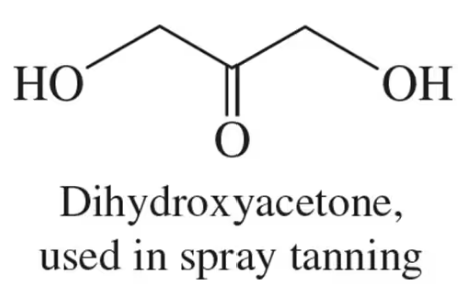
Mark the chiral centers in the following molecules, if any, with an asterisk (*).
(d) 
검증된 단계별 안내1
Identify the structure of dihydroxyacetone. Dihydroxyacetone is a simple carbohydrate with the molecular formula C3H6O3. Its structure consists of a three-carbon chain with two hydroxyl (-OH) groups and one carbonyl (C=O) group.
Recall the definition of a chiral center. A chiral center is a carbon atom that is bonded to four different groups or atoms. This asymmetry makes the carbon atom chiral.
Examine each carbon atom in the dihydroxyacetone molecule. Start with the first carbon, then the second, and finally the third. Check if each carbon is bonded to four distinct groups.
Analyze the central carbon atom (C2) in dihydroxyacetone. This carbon is part of the carbonyl group (C=O) and is bonded to two other carbons. Since it does not have four distinct groups, it is not a chiral center.
Conclude that dihydroxyacetone does not have any chiral centers. None of the carbon atoms in the molecule meet the criteria for chirality, as no carbon is bonded to four unique groups.

비슷한 문제에 대한 검증된 영상 답변:
이 영상 해법은 위 문제에 도움이 된다고 튜터들이 추천한 것입니다.
영상 길이:
2m주요 개념
질문에 올바르게 답하기 위해 반드시 이해해야 하는 핵심 개념들은 다음과 같습니다.
Chirality
Chirality refers to the geometric property of a molecule that makes it non-superimposable on its mirror image. A chiral molecule typically has at least one carbon atom bonded to four different substituents, creating two distinct forms known as enantiomers. Understanding chirality is crucial in fields like pharmacology, as different enantiomers can have different biological effects.
추천 영상:
가이드 코스
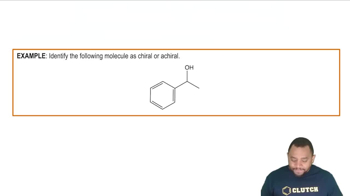
Chirality Example 1
Chiral Centers
A chiral center, often a carbon atom, is a point in a molecule where the interchange of two groups produces a stereoisomer. Identifying chiral centers is essential for determining the stereochemistry of a compound. In the context of the question, marking these centers helps in understanding the molecule's potential interactions and reactivity.
추천 영상:
가이드 코스
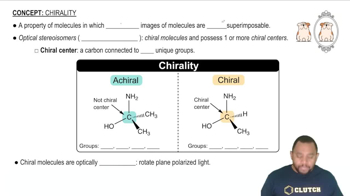
Chirality Concept 1
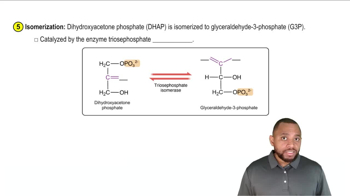
Dihydroxyacetone
Dihydroxyacetone (DHA) is a simple carbohydrate and the active ingredient in many self-tanning products. It is a three-carbon molecule with two hydroxyl groups, but it does not have any chiral centers, as it does not possess a carbon atom bonded to four different groups. Recognizing the structure and properties of DHA is important for understanding its application in cosmetic chemistry.
추천 영상:
가이드 코스
Glycolysis Concept 5
관련 실천
교과서 질문
635
views
교과서 질문
Are the following compounds structural isomers, cis–trans isomers, or enantiomers?
(c)
784
views
교과서 질문
Draw the enantiomer of each of the following compounds. If the compound is not chiral, state that fact.
(c)
41
views
교과서 질문
Draw the skeletal structure and give the name and omega number of the following fatty acid:
CH3CH2CH2CH2CH2HC=CHCH2HC=CHCH2CH2CH2CH2CH2CH2CH2COOH
670
views
교과서 질문
Mark the chiral centers in the following molecules, if any, with an asterisk (*).
(a)
517
views
교과서 질문
Mark the chiral centers in the following molecules, if any, with an asterisk (*).
(d)
564
views
