Ch. 4 - Microscopy, Staining, and Classification
Bauman - Microbiology with Diseases by Taxonomy 6th Edition
Bauman6th EditionMicrobiology with Diseases by TaxonomyISBN: 9780134832302당신이 사용하는 게 아니라요?교과서 변경
4장, 문제 2

A nanometer is _______ than a micrometer.
a. 10 times larger
b. 10 times smaller
c. 1000 times larger
d. 1000 times smaller

검증된 단계별 안내
1
Understand the units involved: a nanometer (nm) and a micrometer (µm) are both units of length used to measure very small distances, commonly in microbiology and nanotechnology.
Recall the relationship between nanometers and micrometers: 1 micrometer (µm) is equal to 1000 nanometers (nm). This means that a micrometer is larger than a nanometer.
Analyze the question: since 1 µm = 1000 nm, a nanometer is smaller than a micrometer by a factor of 1000.
Translate this relationship into the options given: the nanometer is 1000 times smaller than a micrometer.
Therefore, the correct choice corresponds to the statement that a nanometer is 1000 times smaller than a micrometer.

비슷한 문제에 대한 검증된 영상 답변:

이 영상 해법은 위 문제에 도움이 된다고 튜터들이 추천한 것입니다.
영상 길이:
1m
도움이 되었나요?

주요 개념

질문에 올바르게 답하기 위해 반드시 이해해야 하는 핵심 개념들은 다음과 같습니다.

Units of Measurement in Microscopy

Nanometers and micrometers are units used to measure very small lengths, especially in microbiology. A nanometer (nm) is one billionth of a meter, while a micrometer (µm) is one millionth of a meter. Understanding these units helps in comparing sizes of microorganisms and cellular structures.
추천 영상:
가이드 코스
03:46
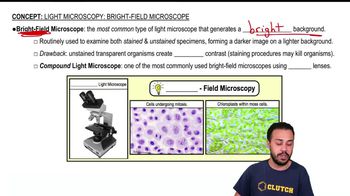
Light Microscopy: Bright-Field Microscopes

Conversion Between Nanometers and Micrometers

To convert between nanometers and micrometers, remember that 1 micrometer equals 1000 nanometers. This means a nanometer is 1000 times smaller than a micrometer. This conversion is essential for interpreting microscopic measurements accurately.
추천 영상:
가이드 코스
03:37
Lysogenic Conversion

Scale and Magnitude in Microbiology

Grasping the scale difference between nanometers and micrometers is crucial for understanding the size of microbes and cellular components. Since many bacteria and viruses are measured in these units, knowing their relative sizes aids in visualizing and studying microscopic life forms.
추천 영상: