뒤로
뒤로
문제 1b(ii,iii)
(ii) Which side of the reaction is favored by entropy? (iii) If ∆S° = 0 for these reactions, calculate ∆G° (Assume T = 298 K) [BDE for O―H = 110 kcal /mol.]
(b)
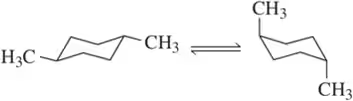
문제 2a
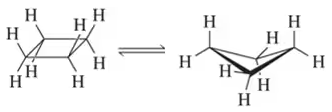
Predict which side of the equilibrium is favored for each of the chair–chair interconversions (ring flips) shown.
(a)
문제 2c
Predict which side of the equilibrium is favored for each of the chair–chair interconversions (ring flips) shown.
(c)
문제 3a
Which is the most stable base in each pair?
(a)
문제 3b
Which is the most stable base in each pair?
(b) HS– and HO–
문제 3c
Which is the most stable base in each pair?
(c) NH3 vs. H2O
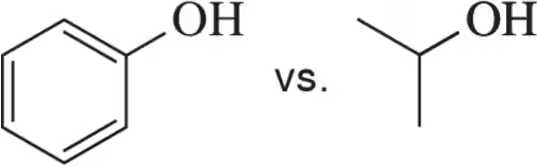
문제 4a
Which is the most acidic compound in each pair?
(a)
문제 4b
Which is the most acidic compound in each pair?
(b) HF vs. HCl
문제 4c
Which is the most acidic compound in each pair?
(c)
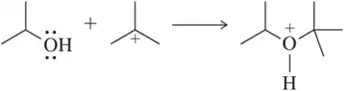
문제 6a
Provide a reasonable arrow-pushing mechanism for the following Lewis acid–Lewis base reactions.
(a)
문제 6b
Provide a reasonable arrow-pushing mechanism for the following Lewis acid–Lewis base reactions.
(b)
문제 7.2
Chapter 5 taught us that chemical reactions are random collisions. Experimentally, how can we make molecules collide more often?
문제 7a
For the following equilibrium processes and the corresponding ∆G°, indicate whether you expect the equilibrium constant to be greater than, equal to, or less than 1. Justify your expectation in words.
(a)
문제 7b
For the following equilibrium processes and the corresponding ∆G° , indicate whether you expect the equilibrium constant to be greater than, equal to, or less than 1. Justify your expectation in words.
(b)
문제 10a
For the following equilibrium processes and the corresponding ∆G°, calculate (i) Keq and (ii) the % composition of the equilibrium mixture (% reactants, % products) at 298 K.
(a)
문제 10b
For the following equilibrium processes and the corresponding ∆G°, calculate (i) Keq and (ii) the % composition of the equilibrium mixture (% reactants, % products) at 298 K.
(b)
문제 11a
For the following values of ∆H° , ∆S°, and T, tell whether the process would be favored.
(a) ∆H° = -15 kcal/mol ; ∆S° = +37 cal/mol•K ; T = 273 K
문제 11b
For the following values of ∆H° , ∆S°, and T, tell whether the process would be favored.
(b) ∆H° = +7.34 kcal/mol ; ∆S° = +43 cal/mol•K ; T = 325 K
문제 11c
For the following values of ∆H° , ∆S°, and T, tell whether the process would be favored.
(c) ∆H° = -21.3 kcal/mol ; AS° = -51 cal/mol•K ; T = 373 K
문제 11d
For the following values of ∆H° , ∆S°, and T, tell whether the process would be favored.
(d) ∆H° = -8.3 kcal/mol ; ∆S° = -12 cal/mol•K ; T = 298 K
문제 12a
At what temperature does the entropy change of a process not contribute to the favorability of a process?
- Which of the following carbocations would you expect to undergo rearrangement?
문제 13
문제 13a
A certain process has ∆H° = 11.7 kcal/mol and AS° = +33cal/mol•K . That is, this reaction has an unfavorable enthalpy but a favorable entropy term. At what temperature will the process be neither favored nor disfavored?
문제 14a
Considering the process described in Assessment 5.13, will it be favored or disfavored at a temperature higher than the one you calculated? How about at a temperature below what you calculated?
문제 15a
Calculate ∆H° for the following equilibrium processes.
(a)
문제 15b
Calculate ∆H° for the following equilibrium processes.
(b)
문제 15d
Calculate ∆H° for the following equilibrium processes.
(d)
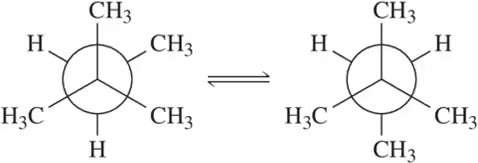
문제 16a
Which conformation in each of the following pairs has the least strain energy?
(a)
문제 16b
Which conformation in each of the following pairs has the least strain energy?
(b)
문제 16c
Which conformation in each of the following pairs has the least strain energy?
(c)