Ch. 5 - Chemical Reaction Analysis: Thermodynamics and Kinetics
Mullins - Organic Chemistry: A Learner Centered Approach 1st Edition
Mullins1st EditionOrganic Chemistry: A Learner Centered ApproachISBN: 9780137566471당신이 사용하는 게 아니라요?교과서 변경
4장, 문제 13a

A certain process has ∆H° = 11.7 kcal/mol and AS° = +33cal/mol•K . That is, this reaction has an unfavorable enthalpy but a favorable entropy term. At what temperature will the process be neither favored nor disfavored?

검증된 단계별 안내
1
Identify the condition for a process to be neither favored nor disfavored. This occurs when the Gibbs free energy change (∆G°) is equal to zero. The equation for Gibbs free energy is: ∆G° = ∆H° - T∆S°.
Set ∆G° to zero in the equation: 0 = ∆H° - T∆S°. Rearrange the equation to solve for temperature (T): T = ∆H° / ∆S°.
Convert the units of ∆H° and ∆S° to ensure consistency. ∆H° is given in kcal/mol, so convert it to cal/mol: ∆H° = 11.7 \, \(\text{kcal/mol}\) \, × \, 1000 \, \(\text{cal/kcal}\) = 11700 \, \(\text{cal/mol}\). ∆S° is already in cal/mol·K, so no conversion is needed.
Substitute the values of ∆H° and ∆S° into the equation for T: T = 11700 \, \(\text{cal/mol}\) / 33 \, \(\text{cal/mol·K}\).
Perform the division to calculate the temperature (T) in Kelvin. This will give the temperature at which the process is neither favored nor disfavored.

비슷한 문제에 대한 검증된 영상 답변:

이 영상 해법은 위 문제에 도움이 된다고 튜터들이 추천한 것입니다.
영상 길이:
4m

주요 개념

질문에 올바르게 답하기 위해 반드시 이해해야 하는 핵심 개념들은 다음과 같습니다.

Gibbs Free Energy

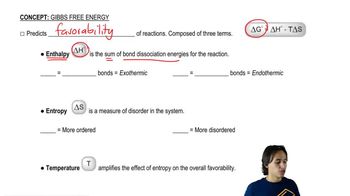
Gibbs Free Energy (G) is a thermodynamic potential that helps predict the favorability of a reaction at constant temperature and pressure. It is defined by the equation G = ∆H - T∆S, where ∆H is the change in enthalpy, T is the temperature in Kelvin, and ∆S is the change in entropy. A reaction is spontaneous when G is negative, indicating that the process can occur without external energy input.
추천 영상:
05:02
Breaking down the different terms of the Gibbs Free Energy equation.

Enthalpy (∆H)

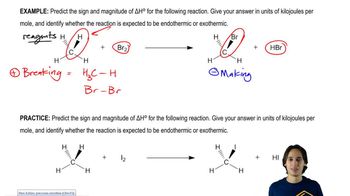
Enthalpy (∆H) is a measure of the total heat content of a system. In the context of a chemical reaction, a positive ∆H indicates that the reaction absorbs heat from the surroundings, making it endothermic. This can lead to an unfavorable reaction under certain conditions, as it requires energy input to proceed.
추천 영상:
04:38
Calculating Enthalpies

Entropy (∆S)

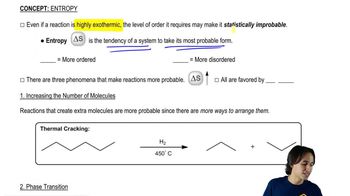
Entropy (∆S) is a measure of the disorder or randomness in a system. A positive change in entropy suggests that the products of a reaction are more disordered than the reactants, which is generally favorable for spontaneity. In the Gibbs Free Energy equation, a favorable entropy can offset an unfavorable enthalpy, influencing the overall spontaneity of the reaction at different temperatures.
추천 영상:
02:46
Explaining what entropy is.