뒤로
뒤로
문제 20a
Show that the [4 + 4] cycloaddition of two butadiene molecules to give cycloocta-1,5-diene is thermally forbidden but photochemically allowed.
문제 20b
There is a different, thermally allowed cycloaddition of two butadiene molecules. Show this reaction, and explain why it is thermally allowed. (Hint: Consider the dimerization of cyclopentadiene.)
문제 21
One milligram of a compound of molecular weight 160 is dissolved in 10 mL of ethanol, and the solution is poured into a 1-cm UV cell. The UV spectrum is taken, and there is an absorption at λmax = 247 nm. The maximum absorbance at 247 nm is 0.50. Calculate the value of e for this absorption.
문제 22
Match four of the following UV absorption maxima (λmax) with the corresponding compounds: (1) 232 nm; (2) 256 nm; (3) 273 nm; (4) 292 nm; (5) 313 nm; (6) 353 nm.
문제 23
Phenolphthalein is an acid–base indicator that is colorless below pH 8 and red above pH 8. Explain briefly why the first structure is colorless and the second structure is colored.
문제 24
Classify the following dienes and polyenes as isolated, conjugated, cumulated, or some combination of these classifications.
(a) cycloocta-1,4-diene
(b) cycloocta-1,3-diene
(c) cyclodeca-1,2-diene
(d) cycloocta-1,3,5,7-tetraene
(e) cyclohexa-1,3,5-triene (benzene)
(f) penta-1,2,4-triene
문제 25a
Predict the products of the following reactions.
(a) allyl bromide + cyclohexyl magnesium bromide
문제 25b
Predict the products of the following reactions.
(b) cyclopentadiene + anhydrous HCl
문제 25c
Predict the products of the following reactions.
(c) 2-methylpropene + NBS, light
문제 25d
Predict the products of the following reactions.
(d) furan + trans-1,2-dicyanoethylene
문제 25e
Predict the products of the following reactions.
(e) buta-1,3-diene + bromine water
문제 25f
Predict the products of the following reactions.
(f) hexa-1,3,5-triene + bromine in CCl4
문제 25g
Predict the products of the following reactions.
(g) 1-(bromomethyl)-2-methylcyclopentene, heated in methanol
문제 25h
Predict the products of the following reactions.
(h) cyclopentadiene + methyl acrylate, CH2=CH–COOCH3
문제 25i
Predict the products of the following reactions.
(i)
문제 26a
Show how the reaction of an allylic halide with a Grignard reagent might be used to synthesize the following hydrocarbons.
a. 5-methylhex-1-ene
문제 26b
Show how the reaction of an allylic halide with a Grignard reagent might be used to synthesize the following hydrocarbons.
b. 2,5,5-trimethylhept-2-ene
문제 26c
Show how the reaction of an allylic halide with a Grignard reagent might be used to synthesize the following hydrocarbons.
c. 1-cyclopentylpent-2-ene
문제 27a
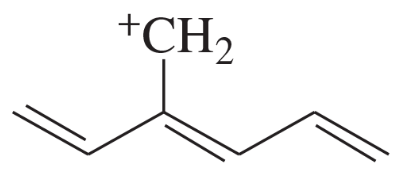
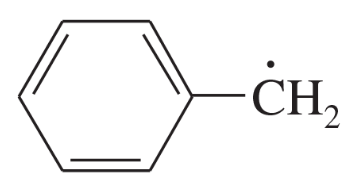
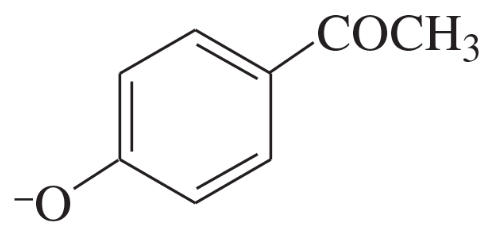
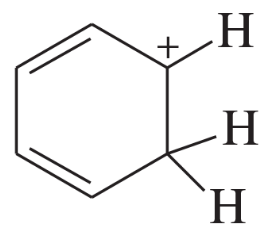
Draw the important resonance contributors for the following cations, anions, and radicals.
(a)
문제 27b
Draw the important resonance contributors for the following cations, anions, and radicals.
(b)
문제 27c
Draw the important resonance contributors for the following cations, anions, and radicals.
(c)
문제 27d
Draw the important resonance contributors for the following cations, anions, and radicals.
(d)
문제 27e,f
Draw the important resonance contributors for the following cations, anions, and radicals.
(e)
(f)
문제 28
A solution was prepared using 0.0010 g of an unknown steroid (of molecular weight around 255) in 100 mL of ethanol. Some of this solution was placed in a 1-cm cell, and the UV spectrum was measured. This solution was found to have λmax = 235 nm, with A = 0.74.
(a) Compute the value of the molar absorptivity at 235 nm.
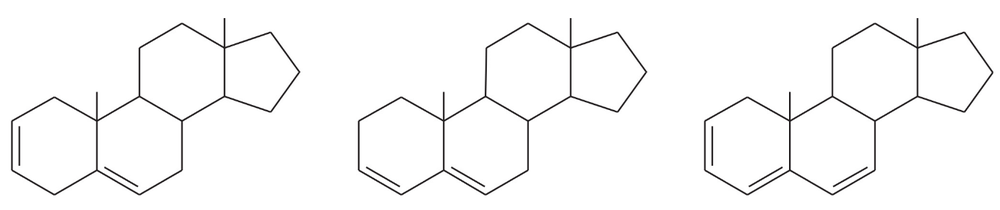
(b) Which of the following compounds might give this spectrum?
문제 29b
The diene lactone shown in part (a) has one electron-donating group (-OR) and one electron-withdrawing group (C=O). This diene lactone is sufficiently electron-rich to serve as the diene in a Diels–Alder reaction.
b. The Diels–Alder product A is not very stable. Upon mild heating, it reacts to produce CO2 gas and methyl benzoate (PhCOOCH3), a very stable product. Explain how this strongly exothermic decarboxylation takes place. (Hint: Under the right conditions, the Diels–Alder reaction can be reversible.)
문제 30a
Predict the products of the following proposed Diels–Alder reactions. Include stereochemistry where appropriate.
(a)
문제 30d
Predict the products of the following proposed Diels–Alder reactions. Include stereochemistry where appropriate.
(d)
문제 30e,f
Predict the products of the following proposed Diels–Alder reactions. Include stereochemistry where appropriate.
(e)
(f)
문제 31a,b,c
Predict the products of the following proposed Diels–Alder reactions. Include stereochemistry where appropriate.
(a)
(b)
(c)
문제 33a,b
Show how Diels–Alder reactions might be used to synthesize the following compounds.
(a)
(b)