Ch 03: Vectors and Coordinate Systems
Knight Calc - Physics for Scientists and Engineers 5th Edition
Knight Calc5th EditionPhysics for Scientists and EngineersISBN: 9780137344796당신이 사용하는 게 아니라요?교과서 변경
3장, 문제 9

A runner is training for an upcoming marathon by running around a 100-m-diameter circular track at constant speed. Let a coordinate system have its origin at the center of the circle with the x-axis pointing east and the y-axis north. The runner starts at (x,y) = (50m, 0m) and runs 2.5 times around the track in aclockwise direction. What is his displacement vector? Give your answer as a magnitude and direction.

검증된 단계별 안내
1
Step 1: Understand the problem. The runner is moving in a circular path with a diameter of 100 m, which means the radius of the circle is 50 m. The runner starts at the point (50 m, 0 m) on the positive x-axis and runs 2.5 times around the circle in a clockwise direction. We need to find the displacement vector, which is the straight-line distance and direction from the starting point to the final point.
Step 2: Calculate the total angular displacement. One full circle corresponds to an angular displacement of 2π radians. Since the runner completes 2.5 revolutions, the total angular displacement is 2.5 × 2π radians. This equals 5π radians. Since the motion is clockwise, the angular displacement is negative: -5π radians.
Step 3: Determine the final angular position. The runner starts at an angle of 0 radians (on the positive x-axis). To find the final angular position, add the total angular displacement to the initial angle. Since -5π radians is equivalent to -π radians (after subtracting multiples of 2π to bring it within one full circle), the final angular position is -π radians. This corresponds to the point (-50 m, 0 m) on the negative x-axis.
Step 4: Calculate the displacement vector. The displacement vector is the straight-line vector from the starting point (50 m, 0 m) to the final point (-50 m, 0 m). The x-component of the displacement is Δx = -50 m - 50 m = -100 m, and the y-component is Δy = 0 m - 0 m = 0 m. Thus, the displacement vector is (-100 m, 0 m).
Step 5: Find the magnitude and direction of the displacement vector. The magnitude of the displacement vector is given by the formula: Δx2 + Δy2. Substituting Δx = -100 m and Δy = 0 m, the magnitude is 100 m. The direction is the angle of the vector relative to the positive x-axis, which is 180° (or π radians) since the vector points directly to the left.

비슷한 문제에 대한 검증된 영상 답변:

이 영상 해법은 위 문제에 도움이 된다고 튜터들이 추천한 것입니다.
영상 길이:
13m
도움이 되었나요?

주요 개념

질문에 올바르게 답하기 위해 반드시 이해해야 하는 핵심 개념들은 다음과 같습니다.

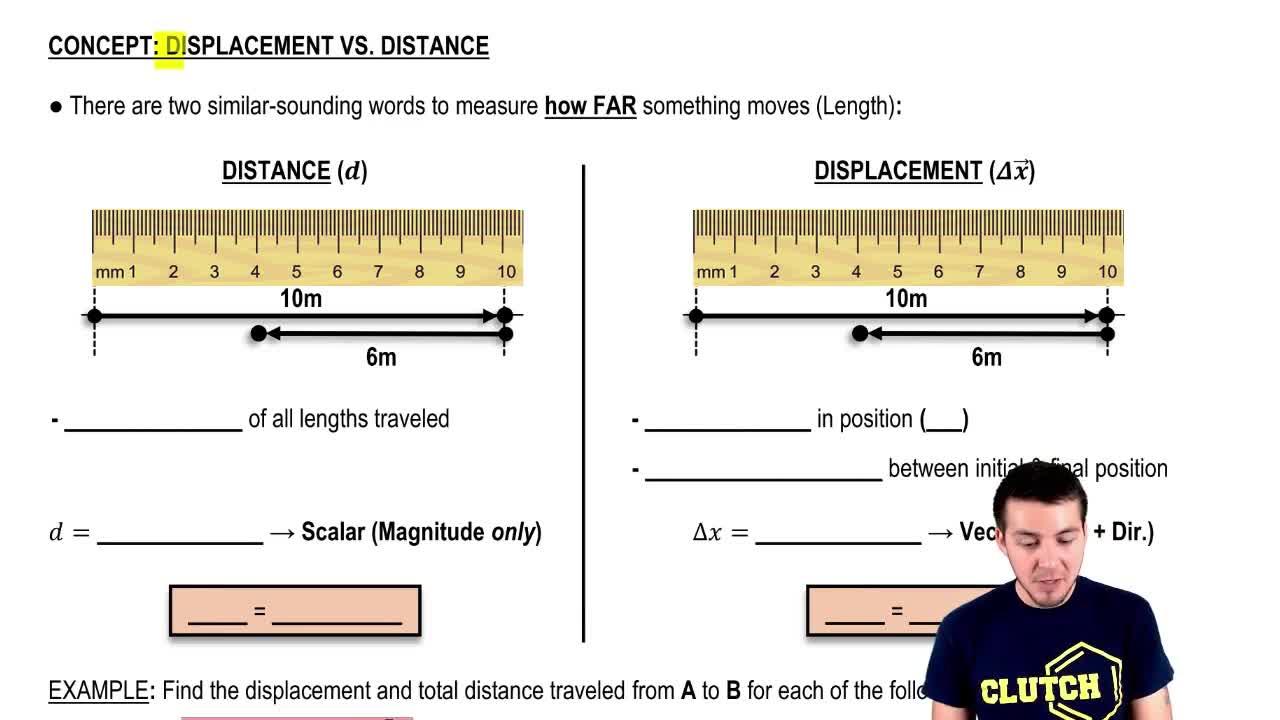
Displacement

Displacement is a vector quantity that refers to the change in position of an object. It is defined as the shortest straight-line distance from the initial position to the final position, along with the direction of that line. In this case, the runner's displacement will be determined by the coordinates of his starting and ending points after completing the laps around the circular track.
추천 영상:
가이드 코스
06:13
Displacement vs. Distance

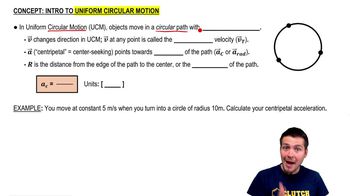
Circular Motion

Circular motion refers to the movement of an object along the circumference of a circle. When an object moves in a circular path at constant speed, it experiences centripetal acceleration directed towards the center of the circle. Understanding circular motion is essential for analyzing the runner's path and determining how many laps he completes around the track.
추천 영상:
가이드 코스
03:48
Intro to Circular Motion

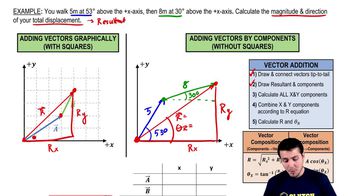
Vector Components

Vector components are the projections of a vector along the axes of a coordinate system. Any vector can be broken down into its horizontal (x-axis) and vertical (y-axis) components. For the runner's displacement, calculating the vector components will help in determining both the magnitude and direction of the displacement vector after running around the track.
추천 영상:
가이드 코스
07:30
Vector Addition By Components