
Ch 03: Vectors and Coordinate Systems
Knight Calc - Physics for Scientists and Engineers 5th Edition
Knight Calc5th EditionPhysics for Scientists and EngineersISBN: 9780137344796당신이 사용하는 게 아니라요?교과서 변경
3장, 문제 8

Let C = (3.15 m, 15 degrees above the neagtive x-axis) and D = (25.6, 30 degrees to the right of the negative y-axis). Find the x and y components of each vector.

검증된 단계별 안내
1
Step 1: Understand the problem. You are tasked with finding the x and y components of two vectors, C and D, given their magnitudes and angles relative to specific axes. Recall that the components of a vector can be calculated using trigonometric functions: cosine for the x-component and sine for the y-component.
Step 2: For vector C, note that its magnitude is 3.15 m and its angle is 15 degrees above the negative x-axis. To find the x-component, use the formula: x_C = magnitude_C × cos(angle_C). Since the angle is above the negative x-axis, the x-component will be negative. For the y-component, use the formula: y_C = magnitude_C × sin(angle_C). The y-component will be positive because the vector points upward.
Step 3: For vector D, note that its magnitude is 25.6 m and its angle is 30 degrees to the right of the negative y-axis. To find the x-component, use the formula: x_D = magnitude_D × sin(angle_D). The x-component will be positive because the vector points to the right. For the y-component, use the formula: y_D = magnitude_D × cos(angle_D). The y-component will be negative because the vector points downward.
Step 4: Substitute the given values into the formulas. For vector C: x_C = 3.15 × cos(15°) and y_C = 3.15 × sin(15°). For vector D: x_D = 25.6 × sin(30°) and y_D = 25.6 × cos(30°). Ensure you use the correct trigonometric functions and account for the signs of the components based on the directions of the vectors.
Step 5: Perform the calculations using a calculator or software to find the numerical values of the components. Remember to keep track of the signs for each component based on the orientation of the vectors relative to the axes.

비슷한 문제에 대한 검증된 영상 답변:

이 영상 해법은 위 문제에 도움이 된다고 튜터들이 추천한 것입니다.
영상 길이:
7m
도움이 되었나요?

주요 개념

질문에 올바르게 답하기 위해 반드시 이해해야 하는 핵심 개념들은 다음과 같습니다.

Vector Components

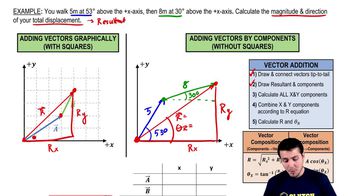
Vector components are the projections of a vector along the axes of a coordinate system, typically the x and y axes. Each vector can be broken down into its horizontal (x) and vertical (y) components using trigonometric functions. For a vector with magnitude and angle, the x-component is found using cosine, while the y-component is found using sine.
추천 영상:
가이드 코스
07:30
Vector Addition By Components

Trigonometric Functions

Trigonometric functions, such as sine and cosine, relate the angles of a triangle to the ratios of its sides. In the context of vectors, these functions are used to calculate the components of a vector based on its angle and magnitude. For example, if a vector makes an angle θ with the x-axis, the x-component is given by the product of the vector's magnitude and cos(θ), while the y-component is given by the product of the magnitude and sin(θ).
추천 영상:
가이드 코스
08:30
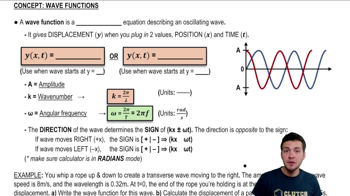
Intro to Wave Functions

Coordinate System Orientation

Understanding the orientation of the coordinate system is crucial for accurately determining vector components. In this case, angles are measured from specific axes, such as the negative x-axis and negative y-axis. This requires careful attention to the direction of the angles, as they can affect the signs of the resulting components, which can be positive or negative depending on the quadrant in which the vector lies.
추천 영상:
가이드 코스
05:17
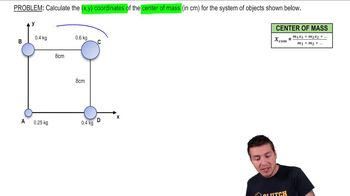
Coordinates of Center of Mass of 4 objects