Ch 03: Vectors and Coordinate Systems
Knight Calc - Physics for Scientists and Engineers 5th Edition
Knight Calc5th EditionPhysics for Scientists and EngineersISBN: 9780137344796당신이 사용하는 게 아니라요?교과서 변경
3장, 문제 10c

Draw each of the following vectors, label an angle that specifies the vector's direction, and then find the vector's magnitude and direction. v = (14i - 11j) m/s

검증된 단계별 안내
1
Step 1: Understand the vector components. The vector v is given as v = (14i - 11j) m/s, where 14i represents the x-component (horizontal direction) and -11j represents the y-component (vertical direction).
Step 2: Draw the vector on a coordinate system. Start at the origin (0, 0). Move 14 units to the right along the x-axis (positive direction) and then move 11 units downward along the y-axis (negative direction). Label the vector v and the angle θ it makes with the positive x-axis.
Step 3: Calculate the magnitude of the vector using the Pythagorean theorem. The magnitude |v| is given by the formula: 142+112. Substitute the values and simplify.
Step 4: Determine the direction of the vector. The angle θ can be calculated using the formula: θ=tan-1-1(-1114). Note that the negative sign in the y-component indicates the vector points downward.
Step 5: Interpret the angle θ. Since the vector lies in the fourth quadrant (positive x-component and negative y-component), adjust the angle if necessary to ensure it is measured counterclockwise from the positive x-axis. Express the direction in degrees or radians as appropriate.

비슷한 문제에 대한 검증된 영상 답변:

이 영상 해법은 위 문제에 도움이 된다고 튜터들이 추천한 것입니다.
영상 길이:
2m
도움이 되었나요?

주요 개념

질문에 올바르게 답하기 위해 반드시 이해해야 하는 핵심 개념들은 다음과 같습니다.

Vector Representation

Vectors are quantities that have both magnitude and direction, represented in a coordinate system. In this case, the vector v = (14i - 11j) m/s can be visualized in a two-dimensional plane, where 'i' represents the x-component and 'j' represents the y-component. Understanding how to graphically represent vectors is essential for visualizing their direction and magnitude.
추천 영상:
06:44
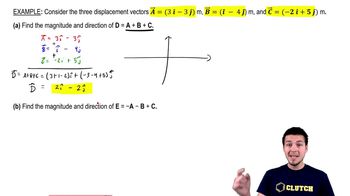
Adding 3 Vectors in Unit Vector Notation

Magnitude of a Vector

The magnitude of a vector is a measure of its length, calculated using the Pythagorean theorem. For the vector v = (14i - 11j) m/s, the magnitude is found by taking the square root of the sum of the squares of its components: |v| = √(14² + (-11)²). This value provides a scalar quantity that represents the strength of the vector.
추천 영상:
03:59
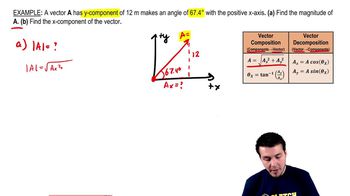
Calculating Magnitude & Components of a Vector

Direction of a Vector

The direction of a vector is often specified by the angle it makes with a reference axis, typically the positive x-axis. This angle can be calculated using the arctangent function: θ = arctan(y/x), where y and x are the vector's components. For the vector v = (14i - 11j) m/s, determining the angle helps in understanding how the vector is oriented in the coordinate system.
추천 영상:
06:44
Adding 3 Vectors in Unit Vector Notation