
Ch 05: Force and Motion
Knight Calc - Physics for Scientists and Engineers 5th Edition
Knight Calc5th EditionPhysics for Scientists and EngineersISBN: 9780137344796당신이 사용하는 게 아니라요?교과서 변경
5장, 문제 14

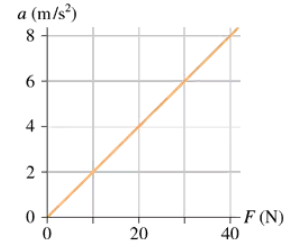
FIGURE EX5.14 shows an object's acceleration-versus-force graph. What is the object's mass?

검증된 단계별 안내
1
Step 1: Recall Newton's Second Law of Motion, which states that \( F = ma \), where \( F \) is the force applied to an object, \( m \) is the object's mass, and \( a \) is the acceleration produced.
Step 2: From the graph, observe that the relationship between force \( F \) and acceleration \( a \) is linear. This indicates that the object's mass \( m \) is constant.
Step 3: To find the mass, calculate the slope of the graph. The slope of the graph is given by \( \text{slope} = \frac{\Delta a}{\Delta F} \), where \( \Delta a \) is the change in acceleration and \( \Delta F \) is the change in force.
Step 4: From the graph, select two points to determine \( \Delta a \) and \( \Delta F \). For example, at \( F = 0 \), \( a = 0 \), and at \( F = 150 \ \text{N} \), \( a = 3 \ \text{m/s}^2 \). Thus, \( \Delta a = 3 \ \text{m/s}^2 \) and \( \Delta F = 150 \ \text{N} \).
Step 5: Substitute the values into the slope formula: \( \text{slope} = \frac{\Delta a}{\Delta F} = \frac{3}{150} \). Since \( \text{slope} = \frac{1}{m} \), rearrange to find \( m = \frac{1}{\text{slope}} \).

비슷한 문제에 대한 검증된 영상 답변:

이 영상 해법은 위 문제에 도움이 된다고 튜터들이 추천한 것입니다.
영상 길이:
3m
도움이 되었나요?

주요 개념

질문에 올바르게 답하기 위해 반드시 이해해야 하는 핵심 개념들은 다음과 같습니다.

Newton's Second Law of Motion

Newton's Second Law states that the acceleration of an object is directly proportional to the net force acting on it and inversely proportional to its mass. This relationship is expressed mathematically as F = ma, where F is the net force, m is the mass, and a is the acceleration. Understanding this law is crucial for analyzing the relationship between force, mass, and acceleration in the given graph.
추천 영상:
가이드 코스
06:54
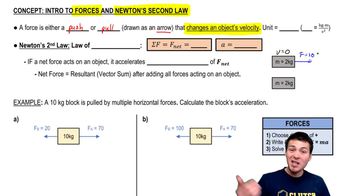
Intro to Forces & Newton's Second Law

Force-Acceleration Graph

A force-acceleration graph plots acceleration on the y-axis against force on the x-axis. The slope of the line in such a graph represents the mass of the object, as per the rearranged form of Newton's Second Law (a = F/m). In this case, the linear relationship indicates that as force increases, acceleration increases proportionally, allowing for the calculation of mass from the slope.
추천 영상:
가이드 코스
07:32
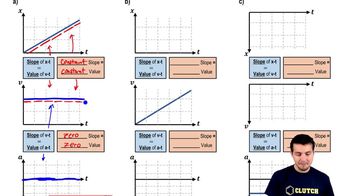
Graphing Position, Velocity, and Acceleration Graphs

Slope of a Line

The slope of a line in a graph represents the rate of change of one variable with respect to another. In the context of the force-acceleration graph, the slope (rise over run) indicates how much acceleration changes for a given change in force. This slope is equal to 1/mass, allowing us to determine the mass of the object by calculating the slope of the line in the graph.
추천 영상:
가이드 코스
01:29
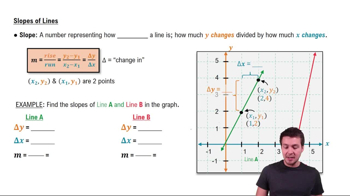
Slopes of Lines