Ch 05: Force and Motion
Knight Calc - Physics for Scientists and Engineers 5th Edition
Knight Calc5th EditionPhysics for Scientists and EngineersISBN: 9780137344796당신이 사용하는 게 아니라요?교과서 변경
5장, 문제 19c

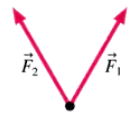
Newton's First Law Exercises 17, 18, and 19 show two of the three forces acting on an object in equilibrium. Redraw the diagram, showing all three forces. Label the third force F3.

검증된 단계별 안내
1
Step 1: Analyze the diagram provided. The forces Fa and Fb are shown acting on an object at equilibrium. Fa is directed downward and to the left, while Fb is directed downward and to the right.
Step 2: Recall Newton's First Law, which states that an object in equilibrium has a net force of zero. This means the vector sum of all forces acting on the object must equal zero.
Step 3: To satisfy equilibrium, the third force F3 must counteract the combined effect of Fa and Fb. F3 should be equal in magnitude but opposite in direction to the resultant vector of Fa and Fb.
Step 4: Calculate the resultant vector of Fa and Fb by adding their components. Use the x and y axes to break down Fa and Fb into their respective components. For example, Fa_x and Fa_y for Fa, and Fb_x and Fb_y for Fb.
Step 5: Draw F3 on the diagram. F3 should originate from the same point as Fa and Fb, but its direction should be opposite to the resultant vector of Fa and Fb. Label this force as F3.

비슷한 문제에 대한 검증된 영상 답변:

이 영상 해법은 위 문제에 도움이 된다고 튜터들이 추천한 것입니다.
영상 길이:
5m
도움이 되었나요?

주요 개념

질문에 올바르게 답하기 위해 반드시 이해해야 하는 핵심 개념들은 다음과 같습니다.

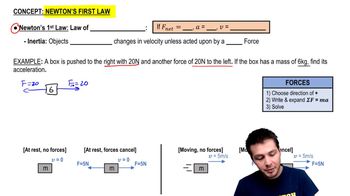
Newton's First Law of Motion

Newton's First Law states that an object at rest will remain at rest, and an object in motion will continue in motion with the same speed and in the same direction unless acted upon by a net external force. This principle highlights the concept of inertia, which is the tendency of an object to resist changes in its state of motion.
추천 영상:
가이드 코스
04:46
Newton's 1st Law

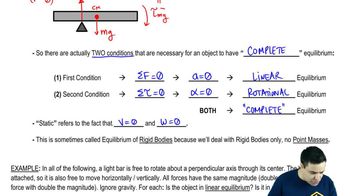
Equilibrium

Equilibrium occurs when the net force acting on an object is zero, resulting in no acceleration. In the context of forces, this means that all forces acting on the object balance each other out. For an object in equilibrium, the vector sum of all forces must equal zero, which is crucial for analyzing static and dynamic systems.
추천 영상:
가이드 코스
10:13
Torque & Equilibrium

Vector Addition

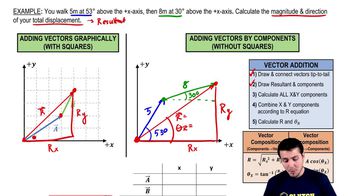
Vector addition is the process of combining two or more vectors to determine a resultant vector. In physics, vectors represent quantities that have both magnitude and direction, such as forces. To find the third force in the equilibrium scenario, one must use vector addition to ensure that the sum of all forces equals zero, allowing for the identification of the missing force.
추천 영상:
가이드 코스
07:30
Vector Addition By Components