
Ch 05: Force and Motion
Knight Calc - Physics for Scientists and Engineers 5th Edition
Knight Calc5th EditionPhysics for Scientists and EngineersISBN: 9780137344796당신이 사용하는 게 아니라요?교과서 변경
5장, 문제 17

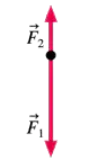
Newton's First Law Exercises 17, 18, and 19 show two of the three forces acting on an object in equilibrium. Redraw the diagram, showing all three forces. Label the third force F3.

검증된 단계별 안내
1
Understand the concept of equilibrium: An object is in equilibrium when the net force acting on it is zero. This means the vector sum of all forces acting on the object must equal zero.
Analyze the given forces: Identify the two forces already provided in the problem. Represent them as vectors in a diagram, ensuring their directions and magnitudes are accurate.
Apply Newton's First Law: Since the object is in equilibrium, the third force (F₃) must be equal in magnitude but opposite in direction to the resultant of the two given forces. This ensures the net force is zero.
Calculate the resultant of the two given forces: Use vector addition to find the resultant force. If the forces are given in components, sum their x-components and y-components separately. For example, \( R_x = F_{1x} + F_{2x} \) and \( R_y = F_{1y} + F_{2y} \).
Determine and draw F₃: The third force \( F_3 \) must have components \( F_{3x} = -R_x \) and \( F_{3y} = -R_y \). Draw \( F_3 \) in the diagram with the appropriate direction and label it clearly.

비슷한 문제에 대한 검증된 영상 답변:

이 영상 해법은 위 문제에 도움이 된다고 튜터들이 추천한 것입니다.
영상 길이:
2m

주요 개념

질문에 올바르게 답하기 위해 반드시 이해해야 하는 핵심 개념들은 다음과 같습니다.

Newton's First Law of Motion

Newton's First Law states that an object at rest will remain at rest, and an object in motion will continue in motion with the same speed and in the same direction unless acted upon by a net external force. This principle highlights the concept of inertia, which is the tendency of an object to resist changes in its state of motion.
추천 영상:
가이드 코스
04:46
Newton's 1st Law

Equilibrium

Equilibrium occurs when the net force acting on an object is zero, resulting in no acceleration. In this state, all forces acting on the object balance each other out, which can be represented graphically by drawing force vectors that sum to zero. Understanding equilibrium is crucial for analyzing forces in static and dynamic situations.
추천 영상:
가이드 코스
10:13
Torque & Equilibrium

Force Vectors

Force vectors are graphical representations of forces that include both magnitude and direction. Each force acting on an object can be represented as an arrow, where the length indicates the force's magnitude and the arrowhead shows its direction. When analyzing forces in equilibrium, it is essential to consider how these vectors interact and combine to maintain a state of balance.
추천 영상:
가이드 코스
06:44
Adding 3 Vectors in Unit Vector Notation