Ch 14: Fluids and Elasticity
Knight Calc - Physics for Scientists and Engineers 5th Edition
Knight Calc5th EditionPhysics for Scientists and EngineersISBN: 9780137344796당신이 사용하는 게 아니라요?교과서 변경
14장, 문제 11b

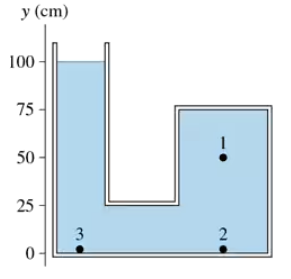
The container shown in FIGURE EX14.11 is filled with oil. It is open to the atmosphere on the left. What is the pressure difference between points 1 and 2? Between points 1 and 3?

검증된 단계별 안내
1
Step 1: Understand the problem. The container is filled with oil and open to the atmosphere on the left. We need to calculate the pressure difference between points 1 and 2, and between points 1 and 3. The pressure difference in a fluid is determined by the hydrostatic pressure equation, which depends on the depth and density of the fluid.
Step 2: Recall the hydrostatic pressure equation: \( P = P_0 + \rho g h \), where \( P \) is the pressure at a given depth, \( P_0 \) is the pressure at the surface (atmospheric pressure in this case), \( \rho \) is the density of the fluid, \( g \) is the acceleration due to gravity, and \( h \) is the depth below the surface.
Step 3: For the pressure difference between points 1 and 2, identify the vertical distance \( h_{12} \) between these two points. The pressure difference \( \Delta P_{12} \) is given by \( \Delta P_{12} = \rho g h_{12} \). Substitute the values for \( \rho \), \( g \), and \( h_{12} \) to calculate the pressure difference.
Step 4: For the pressure difference between points 1 and 3, identify the vertical distance \( h_{13} \) between these two points. The pressure difference \( \Delta P_{13} \) is given by \( \Delta P_{13} = \rho g h_{13} \). Again, substitute the values for \( \rho \), \( g \), and \( h_{13} \) to calculate the pressure difference.
Step 5: Note that atmospheric pressure \( P_0 \) cancels out when calculating pressure differences, as it is the same at all points exposed to the atmosphere. Focus only on the contribution from the fluid's weight (\( \rho g h \)) to determine the pressure differences.

비슷한 문제에 대한 검증된 영상 답변:

이 영상 해법은 위 문제에 도움이 된다고 튜터들이 추천한 것입니다.
영상 길이:
6m

주요 개념

질문에 올바르게 답하기 위해 반드시 이해해야 하는 핵심 개념들은 다음과 같습니다.

Hydrostatic Pressure

Hydrostatic pressure is the pressure exerted by a fluid at rest due to the weight of the fluid above it. It increases with depth, following the equation P = ρgh, where P is the pressure, ρ is the fluid density, g is the acceleration due to gravity, and h is the height of the fluid column. Understanding this concept is crucial for calculating pressure differences in a fluid-filled container.
추천 영상:
가이드 코스
17:04
Pressure and Atmospheric Pressure

Pascal's Principle

Pascal's Principle states that a change in pressure applied to an enclosed fluid is transmitted undiminished throughout the fluid. This principle is essential for understanding how pressure differences can affect fluid behavior in different parts of a container, allowing us to relate pressures at various points within the fluid.
추천 영상:
가이드 코스
14:47
Diffraction with Huygen's Principle

Atmospheric Pressure

Atmospheric pressure is the pressure exerted by the weight of the atmosphere above a given point. At sea level, this pressure is approximately 101.3 kPa. When analyzing pressure differences in a fluid system, it is important to consider atmospheric pressure as a reference point, especially when one side of the container is open to the atmosphere.
추천 영상:
가이드 코스
17:04
Pressure and Atmospheric Pressure