Ch 14: Fluids and Elasticity
Knight Calc - Physics for Scientists and Engineers 5th Edition
Knight Calc5th EditionPhysics for Scientists and EngineersISBN: 9780137344796당신이 사용하는 게 아니라요?교과서 변경
14장, 문제 16

A 2.0 cm ✕ 2.0 cm ✕ 6.0 cm block floats in water with its long axis vertical. The length of the block above water is 2.0 cm. What is the block's mass density?

검증된 단계별 안내
1
Step 1: Understand the problem. The block is floating in water, which means the buoyant force equals the weight of the block. The block's density can be determined using the principle of buoyancy and the ratio of submerged volume to total volume.
Step 2: Calculate the total volume of the block. The block is a rectangular prism, so its volume is given by the formula: \( V_{\text{total}} = \text{length} \times \text{width} \times \text{height} \). Substitute the dimensions: \( V_{\text{total}} = 2.0 \text{ cm} \times 2.0 \text{ cm} \times 6.0 \text{ cm} \).
Step 3: Determine the submerged volume. Since the block floats with 2.0 cm above water, the submerged height is \( 6.0 \text{ cm} - 2.0 \text{ cm} = 4.0 \text{ cm} \). The submerged volume is \( V_{\text{submerged}} = \text{length} \times \text{width} \times \text{submerged height} \). Substitute the values: \( V_{\text{submerged}} = 2.0 \text{ cm} \times 2.0 \text{ cm} \times 4.0 \text{ cm} \).
Step 4: Use the principle of buoyancy to relate the block's density to the density of water. The ratio of the submerged volume to the total volume equals the ratio of the block's density to the density of water: \( \frac{V_{\text{submerged}}}{V_{\text{total}}} = \frac{\rho_{\text{block}}}{\rho_{\text{water}}} \). Rearrange to solve for \( \rho_{\text{block}} \): \( \rho_{\text{block}} = \rho_{\text{water}} \times \frac{V_{\text{submerged}}}{V_{\text{total}}} \).
Step 5: Substitute the known values. The density of water is approximately \( \rho_{\text{water}} = 1.0 \text{ g/cm}^3 \). Use the calculated volumes from Steps 2 and 3 to find the block's density. Ensure units are consistent throughout the calculation.

비슷한 문제에 대한 검증된 영상 답변:

이 영상 해법은 위 문제에 도움이 된다고 튜터들이 추천한 것입니다.
도움이 되었나요?

주요 개념

질문에 올바르게 답하기 위해 반드시 이해해야 하는 핵심 개념들은 다음과 같습니다.

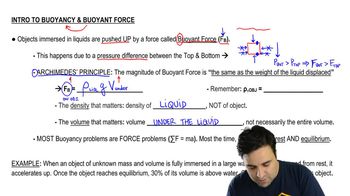
Buoyancy

Buoyancy is the upward force exerted by a fluid on an object submerged in it. This force is equal to the weight of the fluid displaced by the object, as described by Archimedes' principle. In this scenario, the block floats because the buoyant force equals the weight of the block, allowing us to relate the submerged volume to the block's density.
추천 영상:
11:06
Intro to Buoyancy & Buoyant Force

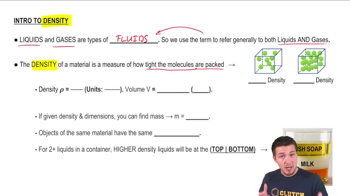
Density

Density is defined as mass per unit volume and is a fundamental property of materials. It is calculated using the formula ρ = m/V, where ρ is density, m is mass, and V is volume. In this problem, determining the block's density involves finding its mass based on the volume of water displaced, which corresponds to the submerged portion of the block.
추천 영상:
8:13
Intro to Density

Volume Displacement

Volume displacement refers to the volume of fluid that is displaced by an object when it is submerged. For floating objects, the volume of fluid displaced is equal to the volume of the object that is submerged. In this case, since the block is partially submerged, the volume of water displaced can be used to find the mass of the block, which is essential for calculating its density.
추천 영상:
05:21
Volume Thermal Expansion