A 2.0 cm ✕ 2.0 cm ✕ 6.0 cm block floats in water with its long axis vertical. The length of the block above water is 2.0 cm. What is the block's mass density?
Ch 14: Fluids and Elasticity
14장, 문제 19
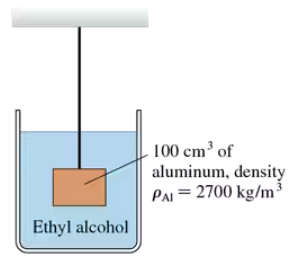
What is the tension of the string in FIGURE EX14.19?

검증된 단계별 안내1
Step 1: Analyze the forces acting on the object in the system. Identify all forces, including the tension in the string, gravitational force, and any other forces present in the diagram provided in FIGURE EX14.19.
Step 2: Write down Newton's second law of motion, \( F = ma \), for the object. Break the forces into components if necessary, such as horizontal and vertical directions.
Step 3: Use trigonometric relationships (e.g., sine, cosine) to resolve the tension force into its components if the string is at an angle. For example, \( T_x = T \cos(\theta) \) and \( T_y = T \sin(\theta) \).
Step 4: Set up equations based on the equilibrium conditions or the motion of the object. For equilibrium, the sum of forces in each direction should equal zero. For motion, account for acceleration using \( F = ma \).
Step 5: Solve the equations for the tension \( T \) in the string. Ensure all variables are substituted correctly, and check the units for consistency.

비슷한 문제에 대한 검증된 영상 답변:
이 영상 해법은 위 문제에 도움이 된다고 튜터들이 추천한 것입니다.
영상 길이:
4m도움이 되었나요?
주요 개념
질문에 올바르게 답하기 위해 반드시 이해해야 하는 핵심 개념들은 다음과 같습니다.
Tension in a String
Tension is the force exerted along the length of a string or rope when it is pulled tight by forces acting from opposite ends. It is a pulling force that acts along the string and is equal in magnitude at both ends, assuming the string is massless and there are no other forces acting on it. Understanding tension is crucial for analyzing systems involving strings, such as pulleys or hanging objects.
추천 영상:
가이드 코스
Energy & Power of Waves on Strings
Equilibrium Conditions
Equilibrium occurs when all the forces acting on an object are balanced, resulting in a state of rest or constant velocity. For a system in equilibrium, the sum of the forces in any direction must equal zero. This principle is essential for solving problems involving tension, as it allows us to set up equations based on the forces acting on the objects connected by the string.
추천 영상:
가이드 코스
Torque & Equilibrium
Free Body Diagram (FBD)
A Free Body Diagram is a graphical representation used to visualize the forces acting on an object. It simplifies the analysis of forces by isolating the object and illustrating all the external forces, including tension, gravity, and any applied forces. Creating an FBD is a fundamental step in solving physics problems, as it helps identify the relationships between forces and facilitates the application of Newton's laws.
추천 영상:
가이드 코스
Free-Body Diagrams
관련 실천
교과서 질문
2091
views
교과서 질문
Styrofoam has a density of 150 kg/m³. What is the maximum mass that can hang without sinking from a 50-cm-diameter Styrofoam sphere in water? Assume the volume of the mass is negligible compared to that of the sphere.
3014
views
교과서 질문
What does the top pressure gauge read in FIGURE EX14.28?
2061
views
교과서 질문
What is the minimum hose diameter of an ideal vacuum cleaner that could lift a 10 kg (22 lb) dog off the floor?
2106
views
교과서 질문
A 6.00-cm-diameter sphere with a mass of 89.3 g is neutrally buoyant in a liquid. Identify the liquid.
1770
views
교과서 질문
A 2.0 mL syringe has an inner diameter of 6.0 mm, a needle inner diameter of 0.25 mm, and a plunger pad diameter (where you place your finger) of 1.2 cm. A nurse uses the syringe to inject medicine into a patient whose blood pressure is 140/100. What is the minimum force the nurse needs to apply to the syringe?
373
views