Ch 18: A Macroscopic Description of Matter
Knight Calc - Physics for Scientists and Engineers 5th Edition
Knight Calc5th EditionPhysics for Scientists and EngineersISBN: 9780137344796당신이 사용하는 게 아니라요?교과서 변경
18장, 문제 25d

A 20-cm-diameter cylinder that is 40 cm long contains 50 g of oxygen gas at 20°C. What is the reading of a pressure gauge attached to the tank?

검증된 단계별 안내
1
Step 1: Convert the given dimensions of the cylinder into SI units. The diameter is 20 cm, so the radius is 10 cm or 0.1 m. The length of the cylinder is 40 cm or 0.4 m. Use these values to calculate the volume of the cylinder using the formula for the volume of a cylinder: \( V = \pi r^2 h \), where \( r \) is the radius and \( h \) is the height.
Step 2: Convert the mass of oxygen gas into moles. The given mass is 50 g, and the molar mass of oxygen (O₂) is approximately 32 g/mol. Use the formula \( n = \frac{m}{M} \), where \( n \) is the number of moles, \( m \) is the mass, and \( M \) is the molar mass.
Step 3: Use the ideal gas law \( PV = nRT \) to calculate the pressure \( P \). Rearrange the formula to solve for \( P \): \( P = \frac{nRT}{V} \). Here, \( R \) is the ideal gas constant (8.314 J/(mol·K)), \( T \) is the temperature in Kelvin, and \( V \) is the volume of the cylinder. Convert the temperature from Celsius to Kelvin using \( T(K) = T(°C) + 273.15 \).
Step 4: Substitute the values for \( n \), \( R \), \( T \), and \( V \) into the equation to calculate the pressure \( P \). Ensure all units are consistent (e.g., volume in cubic meters, temperature in Kelvin).
Step 5: The pressure gauge measures the gauge pressure, which is the absolute pressure minus atmospheric pressure. Subtract the atmospheric pressure (approximately 101,325 Pa) from the calculated absolute pressure to find the gauge pressure.

비슷한 문제에 대한 검증된 영상 답변:

이 영상 해법은 위 문제에 도움이 된다고 튜터들이 추천한 것입니다.
영상 길이:
8m

주요 개념

질문에 올바르게 답하기 위해 반드시 이해해야 하는 핵심 개념들은 다음과 같습니다.

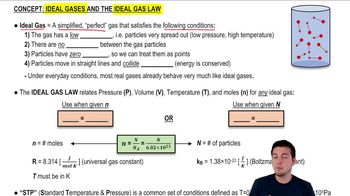
Ideal Gas Law

The Ideal Gas Law relates the pressure, volume, temperature, and number of moles of a gas through the equation PV = nRT. Here, P is pressure, V is volume, n is the number of moles, R is the ideal gas constant, and T is temperature in Kelvin. This law is fundamental for calculating the pressure of gases under various conditions.
추천 영상:
가이드 코스
07:21
Ideal Gases and the Ideal Gas Law

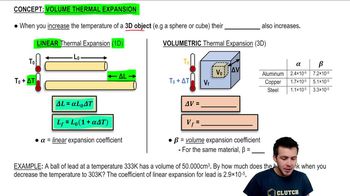
Volume of a Cylinder

The volume of a cylinder can be calculated using the formula V = πr²h, where r is the radius and h is the height. In this case, the diameter of the cylinder is given, so the radius can be found by dividing the diameter by two. Understanding how to calculate the volume is essential for determining the amount of gas present in the cylinder.
추천 영상:
가이드 코스
05:21
Volume Thermal Expansion

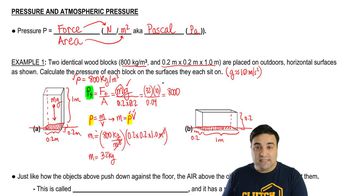
Pressure Measurement

Pressure is defined as the force exerted per unit area and is commonly measured in units such as pascals (Pa) or atmospheres (atm). In the context of gases, pressure can be influenced by the amount of gas, its temperature, and the volume it occupies. Accurate pressure readings are crucial for understanding the behavior of gases in confined spaces.
추천 영상:
가이드 코스
17:04
Pressure and Atmospheric Pressure