A gas at 100°C fills volume V₀. If the pressure is held constant, what is the volume if the Kelvin temperature is doubled?
Ch 18: A Macroscopic Description of Matter
18장, 문제 24
The solar corona is a very hot atmosphere surrounding the visible surface of the sun. X-ray emissions from the corona show that its temperature is about 2×10⁶ K. The gas pressure in the corona is about 0.03 Pa. Estimate the number density of particles in the solar corona.
검증된 단계별 안내1
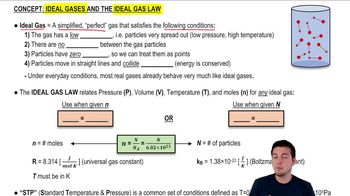
Start by identifying the ideal gas law, which relates pressure, number density, temperature, and the Boltzmann constant: , where is the pressure, is the number density, is the Boltzmann constant, and is the temperature.
Rearrange the ideal gas law to solve for the number density : .
Substitute the given values into the equation: Pa, K, and J/K (Boltzmann constant).
Perform the substitution: .
Simplify the expression to calculate the number density . This will give the estimated number of particles per cubic meter in the solar corona.

비슷한 문제에 대한 검증된 영상 답변:
이 영상 해법은 위 문제에 도움이 된다고 튜터들이 추천한 것입니다.
영상 길이:
6m주요 개념
질문에 올바르게 답하기 위해 반드시 이해해야 하는 핵심 개념들은 다음과 같습니다.
Ideal Gas Law
The Ideal Gas Law relates pressure, volume, temperature, and number of particles in a gas. It is expressed as PV = nRT, where P is pressure, V is volume, n is the number of moles, R is the ideal gas constant, and T is temperature in Kelvin. This law allows us to estimate the number density of particles by rearranging the equation to find n/V, which is crucial for understanding the conditions in the solar corona.
추천 영상:
가이드 코스
Ideal Gases and the Ideal Gas Law
Number Density
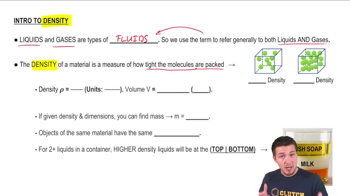
Number density is defined as the number of particles per unit volume, typically expressed in particles per cubic meter. It provides insight into the concentration of particles in a given space, which is essential for analyzing the properties of gases, including those in the solar corona. By using the Ideal Gas Law, we can calculate the number density from the known pressure and temperature of the corona.
추천 영상:
가이드 코스
Intro to Density
Thermal Equilibrium
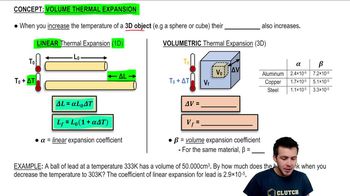
Thermal equilibrium occurs when a system's temperature is uniform throughout, meaning that energy is distributed evenly among particles. In the context of the solar corona, the high temperature of about 2×10^6 K indicates that the particles are in rapid motion, contributing to the gas pressure. Understanding thermal equilibrium helps explain the behavior of the corona's plasma and its interactions with electromagnetic radiation, such as X-rays.
추천 영상:
가이드 코스
Volume Thermal Expansion
관련 실천
교과서 질문
1561
views
교과서 질문
A gas at 100°C fills volume V0. If the pressure is held constant, what is the volume if the Celsius temperature is doubled?
1617
views
교과서 질문
A 20-cm-diameter cylinder that is 40 cm long contains 50 g of oxygen gas at 20°C. What is the reading of a pressure gauge attached to the tank?
1878
views
교과서 질문
The total lung capacity of a typical adult is 5.0 L. Approximately 20% of the air is oxygen. At sea level and at a body temperature of 37°C, how many oxygen molecules do the lungs contain at the end of a strong inhalation?
2776
views
교과서 질문
A 20-cm-diameter cylinder that is 40 cm long contains 50 g of oxygen gas at 20°C. What is the number density of the oxygen?
1618
views
1
rank
교과서 질문
A gas with initial state variables p1, V1, and T1 is cooled in an isochoric process until p2 = (1/3)p1. What are V2?
1854
views