Ch 18: A Macroscopic Description of Matter
Knight Calc - Physics for Scientists and Engineers 5th Edition
Knight Calc5th EditionPhysics for Scientists and EngineersISBN: 9780137344796당신이 사용하는 게 아니라요?교과서 변경
18장, 문제 21a

A gas at 100°C fills volume V0. If the pressure is held constant, what is the volume if the Celsius temperature is doubled?

검증된 단계별 안내
1
Understand the relationship between temperature and volume for a gas at constant pressure. This is described by Charles's Law, which states that \( \frac{V_1}{T_1} = \frac{V_2}{T_2} \), where \( V \) is the volume and \( T \) is the absolute temperature in Kelvin.
Convert the initial temperature from Celsius to Kelvin. The formula for conversion is \( T(K) = T(°C) + 273.15 \). For \( T_1 = 100°C \), calculate \( T_1(K) = 100 + 273.15 \).
Double the Celsius temperature as stated in the problem. If the initial temperature is \( 100°C \), the new Celsius temperature is \( 2 \times 100 = 200°C \). Convert this to Kelvin: \( T_2(K) = 200 + 273.15 \).
Use Charles's Law to find the new volume \( V_2 \). Rearrange the equation to solve for \( V_2 \): \( V_2 = V_1 \times \frac{T_2}{T_1} \). Substitute \( T_1 \) and \( T_2 \) in Kelvin into the equation.
Simplify the expression to determine the proportional change in volume. Since \( T_2 \) is double \( T_1 \), \( V_2 \) will also be double \( V_1 \). Thus, \( V_2 = 2 \times V_1 \).

비슷한 문제에 대한 검증된 영상 답변:

이 영상 해법은 위 문제에 도움이 된다고 튜터들이 추천한 것입니다.
영상 길이:
4m

주요 개념

질문에 올바르게 답하기 위해 반드시 이해해야 하는 핵심 개념들은 다음과 같습니다.

Charles's Law

Charles's Law states that the volume of a gas is directly proportional to its absolute temperature (in Kelvin) when pressure is held constant. This means that if the temperature increases, the volume will also increase, and vice versa. The relationship can be expressed mathematically as V1/T1 = V2/T2, where V is volume and T is temperature.
추천 영상:

Absolute Temperature

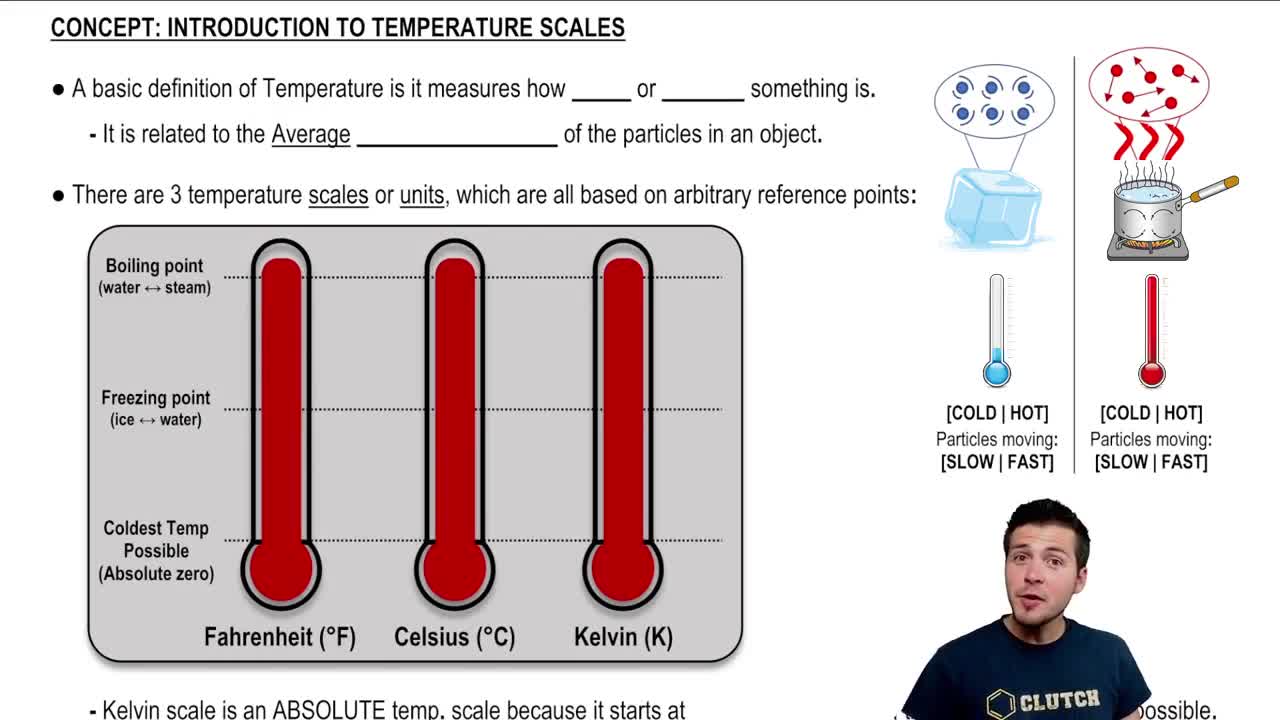
Absolute temperature is measured in Kelvin and is crucial for gas law calculations. It is obtained by adding 273.15 to the Celsius temperature. For example, 100°C corresponds to 373.15 K. Using absolute temperature ensures that the proportional relationships in gas laws are valid, as negative temperatures in Celsius do not make physical sense in this context.
추천 영상:
가이드 코스
04:54
Introduction To Temperature Scales

Volume-Temperature Relationship

The volume-temperature relationship in gases indicates that if the temperature of a gas is doubled (in Kelvin), the volume will also double, provided the pressure remains constant. This principle allows us to predict how changes in temperature affect the volume of a gas, which is essential for solving problems involving gas behavior under varying thermal conditions.
추천 영상:
가이드 코스
05:21
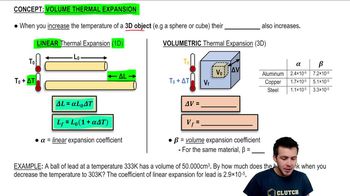
Volume Thermal Expansion
관련 실천
교과서 질문

A cylinder contains nitrogen gas. A piston compresses the gas to half its initial volume. Afterward, has the mass density of the gas changed? If so, by what factor? If not, why not?

1549
views

교과서 질문

A gas at 100°C fills volume V₀. If the pressure is held constant, what is the volume if the Kelvin temperature is doubled?

1561
views
교과서 질문

The total lung capacity of a typical adult is 5.0 L. Approximately 20% of the air is oxygen. At sea level and at a body temperature of 37°C, how many oxygen molecules do the lungs contain at the end of a strong inhalation?

2776
views
교과서 질문

A surveyor has a steel measuring tape that is calibrated to be 100.000 m long (i.e., accurate to ±1 mm) at 20°C. If she measures the distance between two stakes to be 65.175 m on a 3°C day, does she need to add or subtract a correction factor to get the true distance? How large, in mm, is the correction factor?

1622
views
교과서 질문
Common outdoor thermometers are filled with red-colored ethyl alcohol. One thermometer has a 0.40-mm-diameter capillary tube attached to a 9.0-mm-diameter spherical bulb. On a 0°C morning, the column of alcohol stands 30 mm above the bulb. What is the temperature in °C when the column of alcohol stands 130 mm above the bulb? The expansion of the glass is much less than that of the alcohol and can be ignored.
1761
views
1
rank
1
comments
교과서 질문

The solar corona is a very hot atmosphere surrounding the visible surface of the sun. X-ray emissions from the corona show that its temperature is about 2×10⁶ K. The gas pressure in the corona is about 0.03 Pa. Estimate the number density of particles in the solar corona.

2367
views