Ch 22: Electric Charges and Forces
Knight Calc - Physics for Scientists and Engineers 5th Edition
Knight Calc5th EditionPhysics for Scientists and EngineersISBN: 9780137344796당신이 사용하는 게 아니라요?교과서 변경
22장, 문제 65c

A 10.0 nC charge is located at position (x, y)=(1.0 cm, 2.0 cm). At what (x, y) position(s) is the electric field (21,600i^28,800j^)(21,600\(\hat{i}\)-28,800\(\hat{j}\)) N/C?

검증된 단계별 안내
1
Step 1: Recall the formula for the electric field due to a point charge: E = k_e * |q| / r^2, where k_e is Coulomb's constant (8.99 × 10^9 \, N \, m^2 / C^2), q is the charge, and r is the distance from the charge to the point where the field is being calculated.
Step 2: The electric field is a vector quantity, so it has both magnitude and direction. The given electric field vector is E = (21,600 \, \(\hat{i}\) - 28,800 \, \(\hat{j}\)) \, N/C. This means the field has components in the x-direction and y-direction. Use the relationship E_x = k_e * |q| * (x - x_0) / r^3 and E_y = k_e * |q| * (y - y_0) / r^3, where (x_0, y_0) is the position of the charge.
Step 3: Calculate the distance r from the charge to the point where the electric field is given. Use the formula r = \(\sqrt{(x - x_0)^2 + (y - y_0)^2}\). Substitute (x_0, y_0) = (1.0 \, \(\text{cm}\), 2.0 \, \(\text{cm}\)) and solve for r.
Step 4: Solve for the coordinates (x, y) by equating the given electric field components to the expressions for E_x and E_y. This will involve solving the system of equations: 21,600 = k_e * |q| * (x - x_0) / r^3 and -28,800 = k_e * |q| * (y - y_0) / r^3.
Step 5: Rearrange the equations to isolate x and y. Substitute the known values of k_e, q = 10.0 \, \(\text{nC}\) = 10.0 × 10^{-9} \, C, and (x_0, y_0). Solve the system of equations to find the coordinates (x, y) where the electric field has the given components.

비슷한 문제에 대한 검증된 영상 답변:

이 영상 해법은 위 문제에 도움이 된다고 튜터들이 추천한 것입니다.
영상 길이:
15m

주요 개념

질문에 올바르게 답하기 위해 반드시 이해해야 하는 핵심 개념들은 다음과 같습니다.

Electric Field

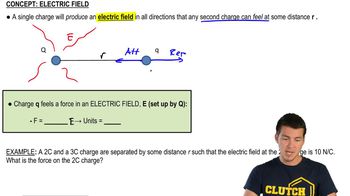
The electric field is a vector field that represents the force exerted by an electric charge on other charges in its vicinity. It is defined as the force per unit charge experienced by a positive test charge placed in the field. The direction of the electric field is away from positive charges and towards negative charges, and its magnitude is measured in newtons per coulomb (N/C).
추천 영상:
가이드 코스
03:16
Intro to Electric Fields

Coulomb's Law

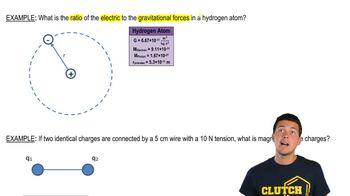
Coulomb's Law describes the electrostatic interaction between charged particles. It states that the force between two point charges is directly proportional to the product of the magnitudes of the charges and inversely proportional to the square of the distance between them. This law is fundamental for calculating the electric field generated by a point charge, as it helps determine the force experienced by other charges in the field.
추천 영상:

Vector Addition

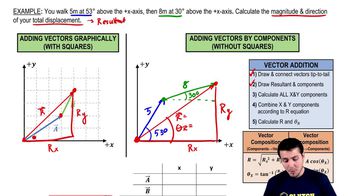
Vector addition is the process of combining two or more vectors to determine a resultant vector. In the context of electric fields, each charge contributes to the total electric field at a point, and these contributions must be added as vectors, taking into account their magnitudes and directions. This is crucial for solving problems involving multiple charges and determining the net electric field at a specific location.
추천 영상:
가이드 코스
07:30
Vector Addition By Components
관련 실천
교과서 질문

An electric field E=200,000i^\(\overrightarrow{E}\)=200,000\(\hat{i}\) N/C causes the point charge in FIGURE P22.68 to hang at an angle. What is θ?

2495
views
1
rank
1
comments

교과서 질문

An electric dipole consists of two opposite charges ±q±q separated by a small distance ss. The product p=qsp=qs is called the dipole moment. Figure P22.6122.61 shows an electric dipole perpendicular to an electric field EE. Find an expression in terms of pp and EE for the magnitude of the torque that the electric field exerts on the dipole.

2311
views
교과서 질문

You have a lightweight spring whose unstretched length is 4.0 cm. First, you attach one end of the spring to the ceiling and hang a 1.0 g mass from it. This stretches the spring to a length of 5.0 cm. You then attach two small plastic beads to the opposite ends of the spring, lay the spring on a frictionless table, and give each plastic bead the same charge. This stretches the spring to a length of 4.5 cm. What is the magnitude of the charge (in nC) on each bead?

2070
views
교과서 질문

Three 1.0 nC charges are placed as shown in FIGURE P22.66. Each of these charges creates an electric field E at a point 3.0 cm in front of the middle charge. What are the three fields E₁, E₂, and E₃ created by the three charges? Write your answer for each as a vector in component form.

1579
views
교과서 질문

The identical small spheres shown in FIGURE P22.64 are charged to +100 nC and −100 nC. They hang as shown in a 100,000 N/C electric field. What is the mass of each sphere?

3382
views
교과서 질문

Starting from rest, how long does it take an electron to move 1.0 cm in a steady electric field of magnitude 100 N/C?

1747
views