Ch 22: Electric Charges and Forces
Knight Calc - Physics for Scientists and Engineers 5th Edition
Knight Calc5th EditionPhysics for Scientists and EngineersISBN: 9780137344796당신이 사용하는 게 아니라요?교과서 변경
22장, 문제 66a

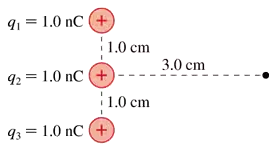
Three 1.0 nC charges are placed as shown in FIGURE P22.66. Each of these charges creates an electric field E at a point 3.0 cm in front of the middle charge. What are the three fields E₁, E₂, and E₃ created by the three charges? Write your answer for each as a vector in component form.
Three 1.0 nC positive charges arranged vertically, with distances labeled, and a point marked 3.0 cm in front of the middle charge.

검증된 단계별 안내
1
Step 1: Understand the problem setup. The three charges are positioned in a specific arrangement, and we need to calculate the electric field contributions (E₁, E₂, and E₃) from each charge at a point 3.0 cm in front of the middle charge. The electric field due to a point charge is given by the formula: Eq = kqr2, where k is Coulomb's constant, q is the charge, and r is the distance from the charge to the point of interest.
Step 2: Identify the distances and directions for each charge relative to the point of interest. For the middle charge, the distance is directly given as 3.0 cm (0.03 m). For the other two charges, calculate their distances using geometry based on their positions in the figure. Also, determine the direction of the electric field vectors created by each charge, as electric fields point away from positive charges and toward negative charges.
Step 3: Calculate the magnitude of the electric field for each charge using the formula Eq = kqr2. Use the value of Coulomb's constant, k = 8.99 × 10⁹ Nm2/C2, and the charge magnitude, 1.0 nC = 1.0 × 10⁻⁹ C. Substitute the distances calculated earlier for r.
Step 4: Break down the electric field vectors into their components. For each charge, use trigonometry to resolve the electric field into x and y components based on the angle of the field vector relative to the axes. For example, the x-component is given by Ex = Ecosθ, and the y-component is given by Ey = Esinθ. Ensure you account for the direction (positive or negative) of each component based on the orientation of the charges.
Step 5: Combine the components of the electric fields from all three charges to express the total electric field at the point in vector form. Add the x-components of E₁, E₂, and E₃ to find the total x-component, and add the y-components to find the total y-component. The final electric field vector will be expressed as E = (Ex, Ey).

비슷한 문제에 대한 검증된 영상 답변:

이 영상 해법은 위 문제에 도움이 된다고 튜터들이 추천한 것입니다.
영상 길이:
10m
도움이 되었나요?

주요 개념

질문에 올바르게 답하기 위해 반드시 이해해야 하는 핵심 개념들은 다음과 같습니다.

Electric Field

An electric field is a region around a charged particle where a force would be exerted on other charges. It is represented as a vector quantity, indicating both the direction and magnitude of the force experienced by a positive test charge placed in the field. The electric field due to a point charge can be calculated using the formula E = k * |q| / r², where k is Coulomb's constant, q is the charge, and r is the distance from the charge.
추천 영상:
가이드 코스
03:16
Intro to Electric Fields

Superposition Principle

The superposition principle states that the total electric field created by multiple charges at a point is the vector sum of the electric fields produced by each charge individually. This means that to find the resultant electric field at a specific point, one must calculate the electric field due to each charge separately and then add these vectors together, taking into account their directions.
추천 영상:
가이드 코스
03:32
Superposition of Sinusoidal Wave Functions

Vector Components

Vectors can be broken down into their components along the axes of a coordinate system, typically the x and y axes in two-dimensional problems. Each vector can be expressed as a sum of its horizontal (x) and vertical (y) components, allowing for easier calculations and visualizations. For electric fields, this means determining the x and y components of the electric field vectors from each charge to find the total electric field at a given point.
추천 영상:
가이드 코스
07:30
Vector Addition By Components