Ch 22: Electric Charges and Forces
Knight Calc - Physics for Scientists and Engineers 5th Edition
Knight Calc5th EditionPhysics for Scientists and EngineersISBN: 9780137344796당신이 사용하는 게 아니라요?교과서 변경
22장, 문제 64

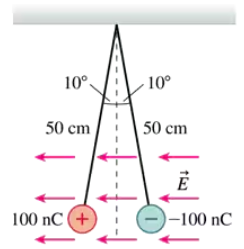
The identical small spheres shown in FIGURE P22.64 are charged to +100 nC and −100 nC. They hang as shown in a 100,000 N/C electric field. What is the mass of each sphere?

검증된 단계별 안내
1
Step 1: Analyze the forces acting on the spheres. Each sphere experiences three forces: (1) the gravitational force \( F_g = m g \), where \( m \) is the mass of the sphere and \( g \) is the acceleration due to gravity, (2) the electric force \( F_e = q E \), where \( q \) is the charge on the sphere and \( E \) is the electric field strength, and (3) the tension force \( T \) in the string, which has both vertical and horizontal components.
Step 2: Break the tension force \( T \) into components. The vertical component \( T_y \) balances the gravitational force \( F_g \), and the horizontal component \( T_x \) balances the electric force \( F_e \). Use the relationships \( T_y = T \cos\theta \) and \( T_x = T \sin\theta \), where \( \theta \) is the angle the string makes with the vertical.
Step 3: Write the equilibrium conditions. For vertical equilibrium: \( T_y = F_g \), which gives \( T \cos\theta = m g \). For horizontal equilibrium: \( T_x = F_e \), which gives \( T \sin\theta = q E \).
Step 4: Divide the horizontal equilibrium equation by the vertical equilibrium equation to eliminate \( T \): \( \frac{T \sin\theta}{T \cos\theta} = \frac{q E}{m g} \). Simplify using \( \tan\theta \): \( \tan\theta = \frac{q E}{m g} \). Rearrange to solve for \( m \): \( m = \frac{q E}{g \tan\theta} \).
Step 5: Substitute the known values into the equation. Use \( q = 100 \, \text{nC} = 100 \times 10^{-9} \text{C} \), \( E = 100,000 \, \text{N/C} \), \( g = 9.8 \, \text{m/s}^2 \), and the given angle \( \theta \) (from the diagram in FIGURE P22.64). Calculate \( \tan\theta \) using the geometry of the setup, and then substitute all values to find \( m \).

비슷한 문제에 대한 검증된 영상 답변:

이 영상 해법은 위 문제에 도움이 된다고 튜터들이 추천한 것입니다.
영상 길이:
11m

주요 개념

질문에 올바르게 답하기 위해 반드시 이해해야 하는 핵심 개념들은 다음과 같습니다.

Electric Force

Electric force is the interaction between charged objects, described by Coulomb's law. In this scenario, the charged spheres experience forces due to their respective charges in the presence of an external electric field. The force acting on a charged object in an electric field can be calculated using the formula F = qE, where F is the force, q is the charge, and E is the electric field strength.
추천 영상:
가이드 코스
14:21
Work due to Electric Force

Weight and Mass

Weight is the force exerted by gravity on an object, calculated as W = mg, where m is the mass and g is the acceleration due to gravity (approximately 9.81 m/s² on Earth). To find the mass of the spheres, we need to relate the electric force acting on them to their weight, as they are in equilibrium under the influence of both forces.
추천 영상:
가이드 코스
10:19
Torque Due to Weight

Equilibrium of Forces

In this context, equilibrium refers to the state where the net force acting on the spheres is zero. This means that the upward electric force must balance the downward gravitational force (weight) acting on each sphere. By setting the electric force equal to the weight, we can solve for the mass of the spheres, allowing us to understand how the charges and the electric field influence their behavior.
추천 영상:
관련 실천
교과서 질문

Two equal point charges 2.5 cm apart, both initially neutral, are being charged at the rate of 5.0 nC/s. At what rate (N/s) is the force between them increasing 1.0 s after charging begins?

279
views

교과서 질문

An electric field E→=200,000i^\(\overrightarrow{E}\)=200,000\(\hat{i}\) N/C causes the point charge in FIGURE P22.68 to hang at an angle. What is θ?

2495
views
1
rank
1
comments
교과서 질문

An electric dipole consists of two opposite charges ±q±q separated by a small distance ss. The product p=qsp=qs is called the dipole moment. Figure P22.6122.61 shows an electric dipole perpendicular to an electric field EE. Find an expression in terms of pp and EE for the magnitude of the torque that the electric field exerts on the dipole.

2311
views
교과서 질문

You have a lightweight spring whose unstretched length is 4.0 cm. First, you attach one end of the spring to the ceiling and hang a 1.0 g mass from it. This stretches the spring to a length of 5.0 cm. You then attach two small plastic beads to the opposite ends of the spring, lay the spring on a frictionless table, and give each plastic bead the same charge. This stretches the spring to a length of 4.5 cm. What is the magnitude of the charge (in nC) on each bead?

2070
views
교과서 질문

Three 1.0 nC charges are placed as shown in FIGURE P22.66. Each of these charges creates an electric field E at a point 3.0 cm in front of the middle charge. What are the three fields E₁, E₂, and E₃ created by the three charges? Write your answer for each as a vector in component form.

1579
views
교과서 질문

A 10.0 nC charge is located at position (x, y)=(1.0 cm, 2.0 cm). At what (x, y) position(s) is the electric field (21,600i^−28,800j^)(21,600\(\hat{i}\)-28,800\(\hat{j}\)) N/C?

1892
views