

Ch 23: The Electric Field
Knight Calc - Physics for Scientists and Engineers 5th Edition
Knight Calc5th EditionPhysics for Scientists and EngineersISBN: 9780137344796당신이 사용하는 게 아니라요?교과서 변경
23장, 문제 44c

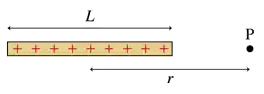
FIGURE P23.44 shows a thin rod of length L with total charge Q. Evaluate E at r=3.0 cm if L=5.0 cm and Q=3.0 nC.
Diagram of a charged rod of length L with charge Q, showing point P at distance r from the rod.

검증된 단계별 안내
1
Understand the problem: We are tasked with finding the electric field (E) at a distance r = 3.0 cm from a thin rod of length L = 5.0 cm and total charge Q = 3.0 nC. The rod is uniformly charged, so the charge per unit length (λ) is constant. The electric field at a point due to a charged rod can be calculated using integration.
Step 1: Define the charge distribution. The linear charge density (λ) is given by λ = Q / L. Substitute the given values for Q and L to find λ.
Step 2: Set up the expression for the electric field. The electric field at a point due to a small charge element (dq) on the rod is given by dE = (1 / (4πε₀)) * (dq / r²), where dq = λ dx and r is the distance from the charge element to the point of interest. Here, ε₀ is the permittivity of free space.
Step 3: Integrate to find the total electric field. Since the rod is thin and lies along a straight line, the electric field components perpendicular to the rod cancel out, leaving only the horizontal component. The total electric field is E = (1 / (4πε₀)) * ∫(λ dx / r²), where the limits of integration are from 0 to L.
Step 4: Evaluate the integral. Substitute λ = Q / L and r = 3.0 cm into the integral. Perform the integration to find the electric field E. Finally, substitute the numerical values for Q, L, r, and ε₀ to calculate the magnitude of E.

비슷한 문제에 대한 검증된 영상 답변:

이 영상 해법은 위 문제에 도움이 된다고 튜터들이 추천한 것입니다.
영상 길이:
9m

주요 개념

질문에 올바르게 답하기 위해 반드시 이해해야 하는 핵심 개념들은 다음과 같습니다.

Electric Field (E)

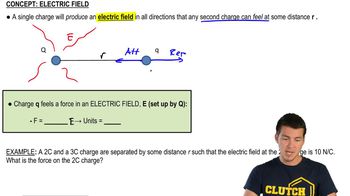
The electric field (E) is a vector field that represents the force per unit charge experienced by a positive test charge placed in the vicinity of electric charges. It is defined mathematically as E = F/q, where F is the force acting on the charge and q is the magnitude of the charge. The direction of the electric field is away from positive charges and towards negative charges.
추천 영상:
가이드 코스
03:16
Intro to Electric Fields

Linear Charge Density (λ)

Linear charge density (λ) is defined as the amount of charge per unit length along a charged object, such as a rod. It is calculated using the formula λ = Q/L, where Q is the total charge and L is the length of the rod. This concept is crucial for determining the electric field produced by a uniformly charged rod.
추천 영상:
가이드 코스
8:13
Intro to Density

Coulomb's Law

Coulomb's Law describes the electrostatic interaction between charged objects. It states that the electric force (F) between two point charges is directly proportional to the product of the magnitudes of the charges (q1 and q2) and inversely proportional to the square of the distance (r) between them, expressed as F = k * (q1 * q2) / r², where k is Coulomb's constant. This law is fundamental in calculating the electric field generated by charge distributions.
추천 영상:
관련 실천
교과서 질문

Charge Q is uniformly distributed along a thin, flexible rod of length L. The rod is then bent into the semicircle shown in FIGURE P23.48. Find an expression for the electric field Ē at the center of the semicircle. Hint: A small piece of arc length Δs spans a small angle Δθ=Δs/R , where R is the radius.

2102
views
교과서 질문

Derive Equation 23.11 for the field Ē dipole in the plane that bisects an electric dipole.

195
views
교과서 질문

A −15 nC charge is at x=+2.0 cm on the x-axis. A second charge q is located somewhere on the x-axis to the left of the origin. The electric field at y=2.0 cm on the y-axis is E=3.0×10⁵i^\(\overrightarrow{E}\)=3.0\(\times\)10^5\(\hat{i}\)N/C . What are (a) the charge q in nC and (b) its distance from the origin?

2589
views
교과서 질문

An infinite plane of charge with surface charge density 3.2 μC/m2 has a 20-cm-diameter circular hole cut out of it. What is the electric field strength directly over the center of the hole at a distance of 12 cm? Hint: Can you create this charge distribution as a superposition of charge distributions for which you know the electric field?

33
views
교과서 질문

FIGURE P23.41 is a cross section of two infinite lines of charge that extend out of the page. Both have linear charge density λ. Find an expression for the electric field strength E at height y above the midpoint between the lines.

2267
views
교과서 질문

A ring of radius R has total charge Q. At what distance along the z-axis is the electric field strength a maximum?

49
views