Ch 23: The Electric Field
Knight Calc - Physics for Scientists and Engineers 5th Edition
Knight Calc5th EditionPhysics for Scientists and EngineersISBN: 9780137344796당신이 사용하는 게 아니라요?교과서 변경
23장, 문제 41

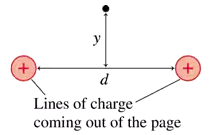
FIGURE P23.41 is a cross section of two infinite lines of charge that extend out of the page. Both have linear charge density λ. Find an expression for the electric field strength E at height y above the midpoint between the lines.
Cross section of two infinite lines of positive charge with a point at height y above the midpoint between them.

검증된 단계별 안내
1
Identify the setup: The problem involves two infinite lines of charge with linear charge density λ. The electric field due to an infinite line of charge is radially outward (or inward for negative charge) and decreases with distance. The goal is to find the net electric field at a point located at height y above the midpoint between the lines.
Write the expression for the electric field due to a single infinite line of charge: The magnitude of the electric field at a distance r from an infinite line of charge is given by the formula: E=12πε₀λr, where λ is the linear charge density, r is the perpendicular distance from the line, and ε₀ is the permittivity of free space.
Determine the geometry: Let the two lines of charge be separated by a distance d. The point of interest is at height y above the midpoint. The distance from the point to each line of charge can be calculated using the Pythagorean theorem: r=y2+d22.
Resolve the electric field components: The electric field due to each line of charge has both horizontal and vertical components. The horizontal components (x-direction) will cancel out because the lines are symmetrically placed, while the vertical components (y-direction) will add up. The vertical component of the electric field from one line is: E_y=12πε₀λryr, where yr accounts for the vertical component.
Combine the contributions: Since there are two lines of charge, the total electric field in the y-direction is twice the vertical component from one line: E=212πε₀λryr. Substitute r=y2+d22 to express the electric field in terms of y, d, and λ.

비슷한 문제에 대한 검증된 영상 답변:

이 영상 해법은 위 문제에 도움이 된다고 튜터들이 추천한 것입니다.
영상 길이:
8m

주요 개념

질문에 올바르게 답하기 위해 반드시 이해해야 하는 핵심 개념들은 다음과 같습니다.

Electric Field Due to a Line of Charge

The electric field generated by an infinite line of charge is directed radially outward (or inward, depending on the charge sign) and decreases with distance from the line. The magnitude of the electric field E at a distance r from a line with linear charge density λ is given by E = (λ / (2πε₀r)), where ε₀ is the permittivity of free space. This concept is crucial for calculating the resultant electric field at a point due to multiple lines of charge.
추천 영상:
가이드 코스
08:20
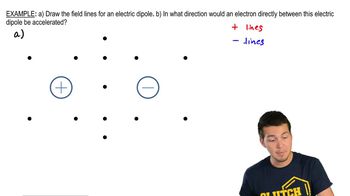
Electric Field Lines

Superposition Principle

The superposition principle states that the total electric field at a point due to multiple charge distributions is the vector sum of the electric fields produced by each charge distribution individually. In this case, the electric fields from both lines of charge must be calculated separately and then combined to find the net electric field at the specified height y above the midpoint.
추천 영상:
가이드 코스
03:32
Superposition of Sinusoidal Wave Functions

Coordinate System and Geometry

Understanding the geometry of the problem is essential for correctly applying the principles of electric fields. In this scenario, the height y and the distance from each line of charge must be accurately represented in a coordinate system. The symmetry of the configuration allows for simplifications in calculations, particularly when determining the direction and magnitude of the electric fields from each line of charge.
추천 영상:
가이드 코스
05:17
Coordinates of Center of Mass of 4 objects